
What Makes an Unboxing Experience Worth the Cost

By
••
7 min read
•Understanding Packaging
Most brands building an unboxing experience are optimising for the wrong outcome.
The goal is usually social sharing — an Instagram moment, a TikTok video, a customer who posts the package before they’ve opened it. That’s not a bad thing to get. But it’s an unpredictable return, hard to measure, and harder to repeat. Designing your packaging around it is the wrong starting point.
The packaging decisions that reliably improve repeat purchase look almost nothing like the ones that generate unboxing content. Understanding the difference is where the spend decision actually starts.
What the Unboxing Moment Actually Does
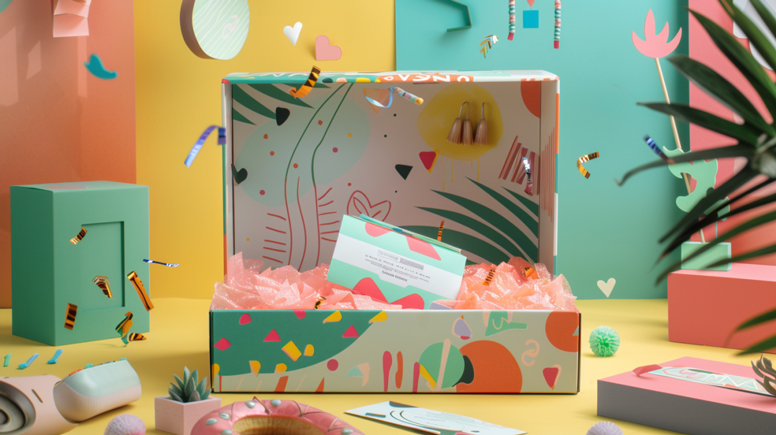
When a customer receives an order, the packaging does one thing before anything else: it sets the expectation for what they’re about to find inside.
A plain brown box with no print signals a functional transaction. A custom-printed mailer box — one with a consistent colour, a clean exterior, and a considered interior — signals that the brand extends past the product itself. That signal lands before the product is touched. It affects how the product is perceived when it is.
This matters most for DTC brands where repeat purchase is the growth model. A customer who receives a first order in generic packaging has no packaging memory to connect to the brand when they consider reordering. A customer who receives a first order in a box that feels deliberate has one more reason to associate the brand with quality — even if they couldn’t articulate it.
This is why the return on unboxing packaging tends to show up in retention data before it shows up anywhere else. Not in share counts or impressions — in whether the customer comes back.
The Box vs the Extras: Where the Work Actually Happens
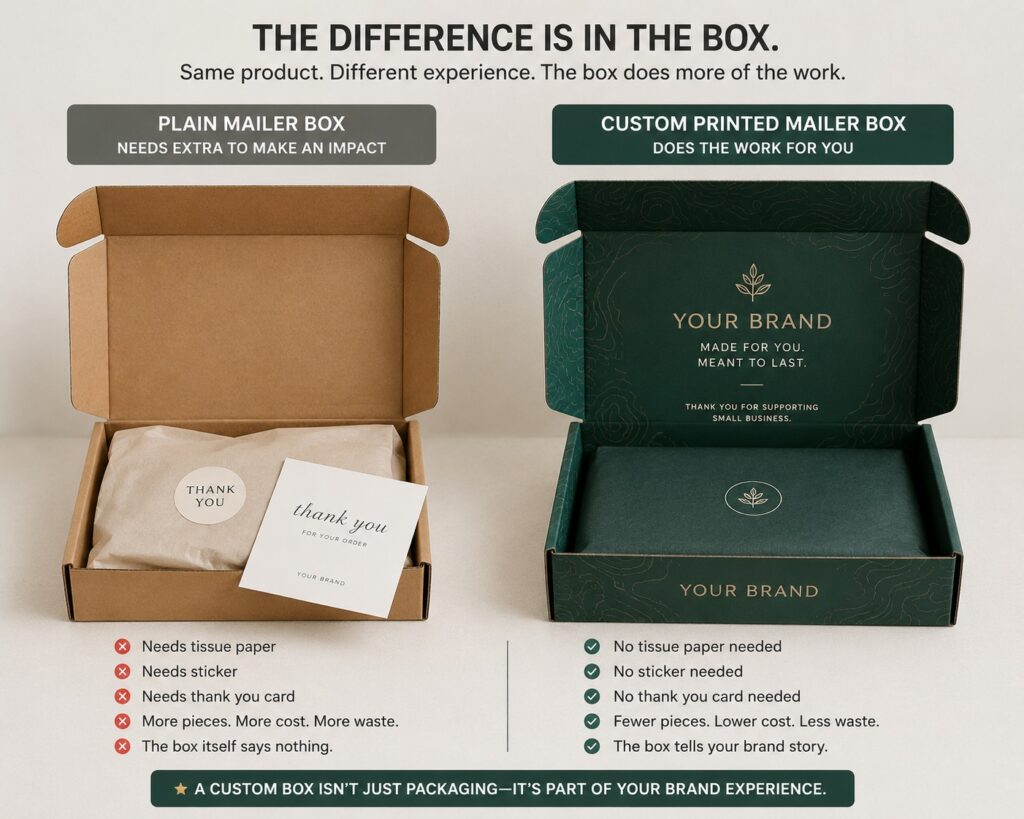
The most common mistake in building an unboxing experience is loading inserts — tissue paper, stickers, branded cards, ribbon, confetti — into a plain or lightly branded box, and assuming the combination adds up to something impressive.
It doesn’t. What the customer registers first is the box. The inserts are secondary. A well-printed custom mailer box with clean structure and nothing else inside will outperform a plain box packed with inserts almost every time. The box sets the context. The inserts operate within it.
Inserts also have a cost that compounds quickly. Each element adds per-order pack time, increases the risk of inconsistency across fulfilment batches, and adds weight that affects shipping cost. A tissue paper and sticker set that costs $0.40 per order becomes $400 across a 1,000-order run — on top of the box cost. For many brands at early scale, that $400 would do more work invested in the box spec than in what goes inside it.
The question to ask before adding any insert: does this make the box better, or does it compensate for the box being ordinary?
What Does a Custom Mailer Box Actually Cost?
The entry point is lower than most brands assume. At Packaging Studio, the minimum run is 150 boxes. Depending on size and configuration, that’s around $1.96 per unit — roughly $294 for a first order.
At that price point, the decision is rarely about whether you can afford the box. It’s about whether the box spec is right for your product. A poorly fitting box — one where the product shifts in transit, or where the lid doesn’t close cleanly — undermines the unboxing moment regardless of how well it’s printed. Getting the structure right before committing to print is worth the time it takes.
The more common margin problem isn’t the box cost — it’s the cost of extras stacked on top of it. If the box is $1.96 and the inserts, tissue, and card add another $0.60–$0.80 per order, the per-order packaging cost is approaching $2.75 before labour. At 500 orders a month, that’s a meaningful line item. At 2,000 orders, it’s material. The box cost tends to stay fixed as volume grows. The insert cost scales with every order.
When to Invest and When to Wait
For most DTC brands shipping physical goods, the case for a custom mailer box is straightforward once a product has found consistent demand. The minimum run of 150 units is achievable at almost any sales volume — the question is whether the order will be reordered regularly enough to justify the setup.
Where waiting makes sense is when the product or pack size is likely to change in the near term. A box that fits a current SKU configuration precisely is a sunk cost if that configuration changes within the next quarter. If a rebrand, reformulation, or product extension is already planned, it is worth delaying the packaging investment until the spec is stable.
The other case for waiting is structural uncertainty. If you’re not yet sure whether your product survives transit reliably in a mailer-style box — as opposed to a shipping box with internal protection — solve that first. A branded box that arrives damaged does more harm than a plain box that arrives intact.
The One Mistake That Wastes the Spend
Brands that invest in a custom mailer box and don’t see a return on it almost always made the same decision: they specced the box around the look they wanted, not around how the product actually ships.
A box that is slightly too large for the product creates void that has to be filled — adding cost and reducing the precision of the unboxing moment. A box with a lid that requires force to close won’t close cleanly after the product is packed, which means the exterior presentation is compromised before the order leaves the warehouse. A box with a wall thickness chosen for cost rather than protection may arrive with dented corners, which the customer registers before they register anything else.
The spec variables that matter most for unboxing are: interior dimensions fitted to the product, lid closure that is firm without requiring force, and wall thickness appropriate for the product weight and transit distance. These are structural decisions, not design decisions. Getting them right is what allows the printed design to do its job.
If you’re speccing a custom mailer box for the first time, the place to start is the interior dimension — measure the product as it will be packed, including any protection layer, and build the box around that. The exterior and print come after the structure is confirmed.
How to Decide: A Working Framework
The variables that actually determine whether a custom mailer box is the right move:
- If your product is DTC and repeat purchase is the growth model → invest in the box before the inserts; the box lands in every order, inserts are often discarded
- If your product is fragile or heavy → confirm the box structure can handle transit before committing to print; a damaged box undoes the presentation
- If your pack size or product configuration is likely to change in the next quarter → wait until the spec is stable before ordering printed packaging
- If you’re planning inserts → ask whether each one makes the box better or compensates for the box being generic; if the latter, redirect that spend to the box itself
- If social sharing is your primary success metric for the packaging spend → re-examine the goal; sharing is unpredictable; retention is the more reliable return on a well-specced box
A custom mailer box starting from 150 units is a practical entry point for most DTC brands. The spec decision — interior dimensions, closure, wall thickness, and print — is where the outcome is determined. Once that’s confirmed, the design follows naturally.
If you’re at the stage of comparing configurations and sizing up what a first order looks like, the Custom Mailer Box page shows the available options with real-time pricing at your volume.
Getting the design right for a custom box is a separate decision from getting the spec right — and it’s worth treating them that way.
The perfect unboxing experience isn’t complicated.
Our team can talk you through every option from matrials to finish, before anything goes to print.
What you should read next

Brad Holmes
Designer & Strategist, Packaging Studio
Brad Holmes is Designer and Strategist at Packaging Studio, with 20+ years’ experience developing creative and technical work for print. His background spans wide format, commercial print, direct-to-customer print, and packaging. His guides focus on the decisions that shape how packaging works in the real world, from presentation and usability to production requirements and customer experience.