
Mailer Box Sizes: How to Choose the Right Fit for Your Product

By
••
6 min read
•Getting Started
A box that’s slightly too small means the product doesn’t fit. A box that’s too large means it moves in transit, needs more void fill, and costs more to ship.
Getting the size right is less complicated than it sounds — but there are a few things about how mailer box dimensions work that catch brands out before they get to the right answer.
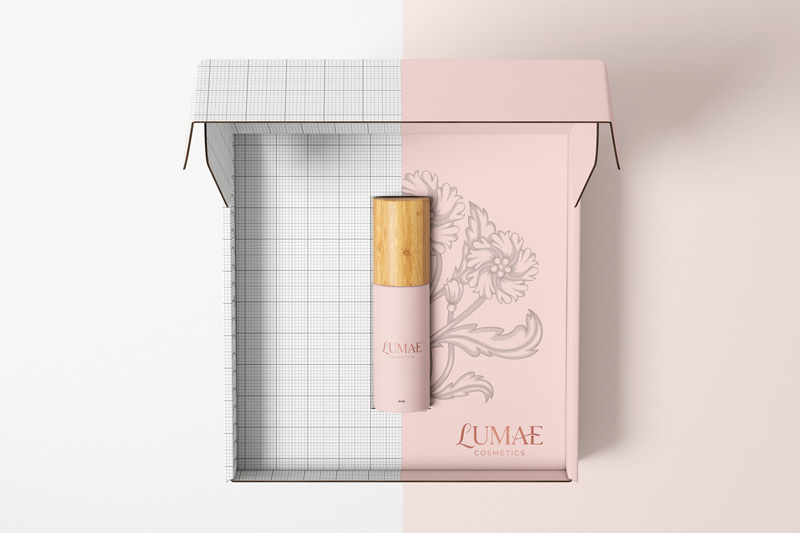
How Mailer Box Dimensions Work
Mailer box sizes are always given as internal dimensions — the usable space inside the box, not the external footprint.
Dimensions are listed as W x L x H: width, then length, then height. Height is the depth of the box when it’s closed — how much vertical space the product has to sit in.
When matching a product to a box, the goal isn’t an exact match. A box where the product fits with zero clearance is harder to pack consistently at volume, and products with no room to settle can shift and cause damage in transit. The standard allowance is 0.25 inches of clearance on each dimension — enough to account for light padding, tissue, or natural product movement without creating a loose, rattling fit.
So if your product measures 3.75 x 3.75 x 1.75 inches, the 4x4x2 is the right starting point, not too small.
The Standard Mailer Sizes
Six standard sizes are available. All dimensions are internal, in inches.
4 x 4 x 2
The smallest standard size. Suited to compact products — jewellery, small cosmetics, single candles, folded accessories, gift cards with a small accompanying item. At 2 inches deep, it handles most products in that footprint without issue. If the product plus any tissue or padding exceeds 2 inches, this size won’t close cleanly.
6 x 6 x 2
A step up in width and length, same 2 inch depth. Works well for slightly larger flat or low-profile products — a pair of sunglasses, small skincare sets, folded garments like socks or a lightweight scarf. The square footprint suits products that don’t have a strong length-to-width ratio.
8 x 5 x 2
A rectangular option at the same depth. Better suited to products with a clear length bias — a slim wallet, a journal, a single skincare product in taller packaging, a long candle. The 5 inch width is the constraint — anything wider needs a different size.
7.5 x 7.5 x 2
The largest square option at standard depth. Suited to larger flat products or small multi-product sets — a candle and a matchbox, a small skincare duo, a folded t-shirt. The 7.5 inch footprint covers a lot of common ecommerce product configurations without going to the largest size.
10 x 12 x 2
The largest standard size at standard depth. Suited to larger flat products, multi-item sets, or anything that needs significant surface area but stays within 2 inches of depth. Subscription box formats often work at this size. At this footprint dimensional weight starts to matter — worth checking shipping cost per unit before committing.
8 x 6 x 4
The only standard size with a 4 inch depth. This is the option for products that don’t fit within 2 inches — a candle in a tall jar, a product in its own rigid retail packaging, anything with a structural insert that adds height. If the product plus packaging exceeds 2 inches, this is the only standard size that works. If the 8×6 footprint doesn’t suit the product either, custom is the right answer.
The 2 Inch Constraint
The most common reason a standard size doesn’t work is height, not footprint.
Five of the six standard sizes have a 2 inch depth. For products that sit flat or low — most jewellery, folded garments, flat cosmetics, cards, small accessories — that’s sufficient. For anything with height — a jar, a bottle, a product in rigid retail packaging, anything with a structural insert — 2 inches closes out most of the standard range immediately.
Before comparing footprints, measure the product height including any packaging or insert it will sit in. If it’s over 2 inches, the choice is the 8x6x4 or custom.
When Custom Sizing Makes Sense
Custom isn’t a premium tier. It’s the right answer when standard sizes don’t fit the product well. Custom mailer boxes start at the same 150 unit minimum as standard sizes.
Go custom when:
- Product height exceeds 4 inches — the 8x6x4 won’t close around it
- The product footprint doesn’t match any standard size without leaving more than 1 to 1.5 inches of empty space in a dimension — excess space means more void fill, more movement in transit, and higher dimensional weight than the product needs
- The product is irregularly shaped and the bounding box is significantly larger than the product itself
- A specific insert or tray is part of the packaging and requires a precise internal dimension to sit correctly
- Presentation requires a proportion that none of the standard sizes provide
Custom sizing doesn’t add significant complexity. The dieline is built to the specified dimensions and the rest of the process — material, finish, artwork setup — runs the same way as a standard order.
Measuring Your Product
Before comparing against any size, measure the product at its largest point in each dimension.
For regular shapes a box, a bottle, a folded garment — that’s straightforward. Measure width at the widest point, length at the longest, height at the tallest.
For irregular shapes a product with a handle, a curved form, anything that protrudes at an angle — measure the bounding box. That’s the smallest rectangular space the product would fit inside if you wrapped it in an invisible cube. The mailer box needs to accommodate that full envelope, not just the product’s main body.
Add 0.25 inches of clearance to each dimension. If the product will sit with padding — tissue paper, a foam insert, a card liner account for the thickness of that material before looking at sizes. A sheet of tissue folds to roughly 0.1 to 0.15 inches. A foam insert can add 0.25 to 0.5 inches per side depending on thickness.
The resulting three numbers are what to match against the size options.
Getting the Clearance Right
Ordering based on the product measurement alone — without clearance — produces a box where the product technically fits but is difficult to pack consistently. At low volumes that’s manageable. At any kind of scale — a product launch, a subscription cycle, a busy fulfilment period — packing a tight box quickly and cleanly becomes a real operational problem.
The 0.25 inch allowance isn’t just about protection in transit. It’s about the box being practical to pack repeatedly, by different people, under time pressure.
Too much clearance creates a different problem. A product rattling in a box that’s significantly too large arrives looking like an afterthought. It also costs more to ship — carriers charge by dimensional weight when it exceeds actual weight, and an oversized box inflates the dimensional calculation on every single shipment.
The target is a fit that’s snug without being tight — product secure, box easy to close, nothing moving more than it needs to.
If the product sits clearly within one of the standard sizes, it can be configured directly on the custom mailer box product page.
Size affects more than fit..
If you’re between sizes or working with an irregular product, our packaging team can help confirm the right dimensions before the order goes in.
Ben Taylor
Product Manager, Packaging Studio
Ben Taylor is Product Manager at Packaging Studio, with 18 years’ experience across commercial print, packaging, and product setup. He understands the practical details behind successful packaging, from substrates and print processes to artwork preparation, design choices, and production requirements. His guides help businesses avoid common setup issues and make more informed packaging decisions before files go to print.