
Pouch Materials: How to Choose the Right Film for Your Product

By
••
7 min read
•Getting Started
The film you choose for a custom pouch does two things at once: it determines how well the product is protected, and it determines how the packaging prints. Choosing for appearance first is the most common mistake — and the most expensive one to fix.
Three films are available across both stand-up and layflat pouches: Opaque White MetPET, Metallic Silver MetPET, and Clear PET/PE laminate. Each one has different barrier performance, different print behaviour, and different shelf-life implications.
Which pouch film should I choose for my product?
Choose Opaque White MetPET if the product is sensitive to oxygen and moisture and needs 12+ month shelf life (coffee, supplements, protein, pet food). Choose Metallic Silver MetPET for mid-barrier products where shelf impact matters (cosmetics, snacks, premium goods). Choose Clear PET/PE only when product visibility is a brand requirement and shelf life is short (3–6 months). All three accept high-quality print; Metallic and Clear require a SPOT white ink layer beneath the artwork.
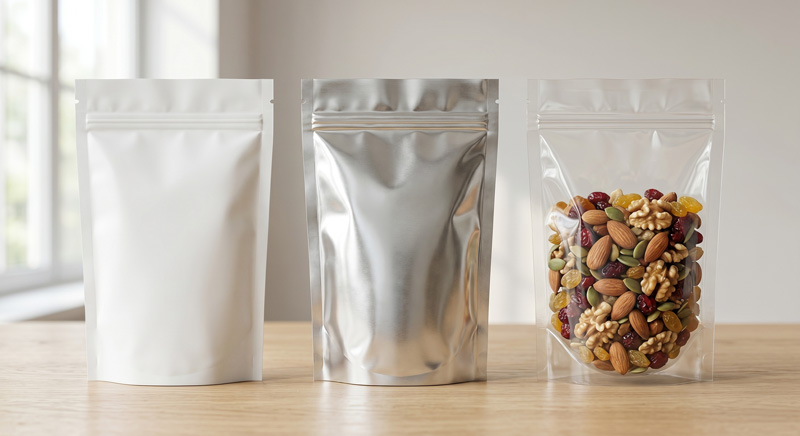
Choose Your Pouch Film: 3-Step Decision
- Define the product’s barrier requirement. What degrades the product? Oxygen exposure (coffee, supplements, anything with fats or volatile compounds), moisture (anything hygroscopic — powders, dried foods, gummies), light (cannabis flower, certain vitamins, some cosmetics)? Match the barrier rating to the degradation pathway. Strong barrier = Opaque White MetPET. Mid barrier = Metallic Silver. Basic barrier = Clear PET/PE.
- Decide whether product visibility is required. If customers need to see the product through the pack — small accessories, dried fruit, craft food, granular consumables — Clear Film is the default. If visibility doesn’t add to the brief, skip Clear and stay with the higher-barrier options.
- Confirm print capability. Opaque White prints standard CMYK directly — simplest file setup. Metallic Silver and Clear both require a SPOT white ink layer beneath the artwork (covered in the pouch artwork setup guide). If the file isn’t being built with SPOT white in mind, default to Opaque White.
Opaque White MetPET
Typical structure: 12µ printed PET / 7µ metallized layer / 80–100µ PE seal layer. Total film gauge ~100–120µ.
Barrier performance: OTR (oxygen transmission rate) ~1–5 cc/m²/day. MVTR (moisture vapour transmission rate) ~1–3 g/m²/day. Light transmission near zero through the metallized layer.
Typical shelf life: 12–24 months for dry goods, depending on product chemistry and headspace.
This is the strongest-barrier option of the three, and the default choice for products that degrade with air, humidity, or light. Coffee, supplements, protein powders, pet food, freeze-dried meals, anything where oxidation or moisture ingress affects freshness — start here.
Print: The white outer surface behaves like coated white paper. Standard CMYK applies directly. No SPOT white layer needed. Colours reproduce accurately and the file setup is the simplest of the three.
Trade-off: The product is not visible through the pack. If visibility is the brand decision, this film is out.
Metallic Silver MetPET
Typical structure: 12µ printed PET with the metallized layer on the outer face, laminated to an 80–100µ PE seal layer. Total gauge ~100–120µ.
Barrier performance: OTR ~5–10 cc/m²/day. MVTR ~2–5 g/m²/day. Light transmission low through the metallized face.
Typical shelf life: 6–18 months for most dry goods. Less than Opaque White MetPET because the metallized layer is on the outside surface rather than embedded in the laminate.
The reflective silver surface creates a distinctive shelf presence. Reads as premium and high-contrast, works well with dark, minimal, or bold design palettes. Cosmetics, supplements, snacks, premium-positioned food brands often choose this film for visual impact at retail.
Print: The reflective surface is semi-transparent at ink coverage level. Standard CMYK applied directly looks muted and colour-shifted. A SPOT white ink layer must be set up beneath the CMYK artwork — white elements, light tints, and any area that needs to read as opaque needs white ink under it. The SPOT white setup adds a step to file preparation but is well-documented.
Trade-off: The reflective surface reduces contrast for fine letterforms. Thin and script fonts at small sizes can be hard to read without strong SPOT white backing.
Clear PET/PE Laminate
Typical structure: 12µ PET printed face / 80µ PE seal layer. Total gauge ~90–100µ. Fully transparent — no metallized or barrier layer.
Barrier performance: OTR ~80–150 cc/m²/day. MVTR ~5–10 g/m²/day. Light transmission high (transparent).
Typical shelf life: 3–6 months for moisture-tolerant products. Not suitable for products that degrade with oxygen, light, or humidity exposure.
The primary use case is visibility. Where customers want to see the product before buying — craft food, granola, dried fruit, small accessories, products where the natural appearance is a selling point — Clear Film is the right call.
Print: Most complex setup of the three. The substrate has no base colour. Every area of the design that needs to read opaque requires a SPOT white ink layer beneath it. Every area intended to be transparent (a window showing the product) needs the white ink absent. The distinction between intentional and accidental transparency must be designed explicitly — the file cannot be ambiguous.
Trade-off: Low barrier rules this film out for any product where shelf life or oxidation is a concern.
Comparison: At a Glance
The three films, summarised:
- Opaque White MetPET — OTR 1–5, MVTR 1–3, shelf life 12–24 months, print complexity low, unit cost low. Best for: coffee, supplements, dry powders, pet food.
- Metallic Silver MetPET — OTR 5–10, MVTR 2–5, shelf life 6–18 months, print complexity mid (SPOT white required), unit cost mid. Best for: cosmetics, snacks, premium retail.
- Clear PET/PE — OTR 80–150, MVTR 5–10, shelf life 3–6 months, print complexity high (SPOT white required), unit cost low. Best for: visibility-driven retail, short shelf-life products.
For products where neither category fits cleanly — high-barrier need plus product visibility, for example — a hybrid laminate with a clear window in an opaque pack is the production answer. Specify this at brief stage.
Common Mistakes to Avoid
1. Choosing for appearance, ignoring barrier. Metallic Silver looks premium but its barrier is mid-tier. Putting coffee, supplements, or any oxygen-sensitive product in Metallic when Opaque White would extend shelf life by 50%+ is the most expensive wrong call in pouch sourcing.
2. Using Clear Film for products with shelf-life concerns. The OTR/MVTR numbers are an order of magnitude higher than MetPET options. A clear pouch shows the product beautifully — for the three months until it goes stale.
3. Specifying Metallic or Clear without SPOT white capability. Both films require the artwork file to include a SPOT white ink layer. If the designer isn’t set up for SPOT white, defaulting to Metallic or Clear produces muted, colour-shifted print that doesn’t match the design brief.
4. Building the file before deciding the substrate. Changing film after artwork is finalised means reworking the file. Substrate is the first decision in pouch artwork, not the last.
Film Choice and Artwork Setup
Substrate choice is the first decision in file setup — before colour mode, before resolution, before anything else. The film determines whether a SPOT white layer is needed, which changes how the entire file is structured.
The full file setup requirements for pouch artwork — SPOT white layer setup in Illustrator, colour values, resolution, bleed, and font handling — are covered in the pouch artwork setup guide.
If the film decision is clear, you can configure your pouch on the stand up pouch product page or the layflat pouch product page.
The right pouch film protects more than the product.
The wrong film can affect shelf life, freshness, product protection, and print quality. If you’re comparing options, we can help you specify the right pouch structure for your product.
Ben Taylor
Product Manager
Packaging Design Specialist and Product Manager with 18 years of experience across commercial print and packaging. Ben knows the industry from the inside out — from substrates and print processes to the design decisions that turn a good product into a great one. He brings that hands-on expertise to every piece he writes, helping businesses make informed decisions about their packaging and get the most from their print.