
Extended Producer Responsibility EPR Packaging Laws: What Brand Owners Need to Know in 2026

By
••
12 min read
•Compliance & Regulation
Your packaging supplier isn’t responsible for EPR compliance. You are.
That distinction matters more in Oregon and California right now than most small brands realise. Both states have passed packaging EPR legislation with compliance obligations that already apply to brand owners — not manufacturers, not printers, not converters. If your name is on the packaging and you sell into either state, the obligation lands with you.
This post covers which EPR packaging laws are active in the US right now, how to determine whether your brand is covered, what you are required to do and when, and how your current packaging spec affects what you will owe in fees. It does not cover every state that is considering EPR legislation — it covers the states where action is required now.
What EPR for Packaging Actually Means
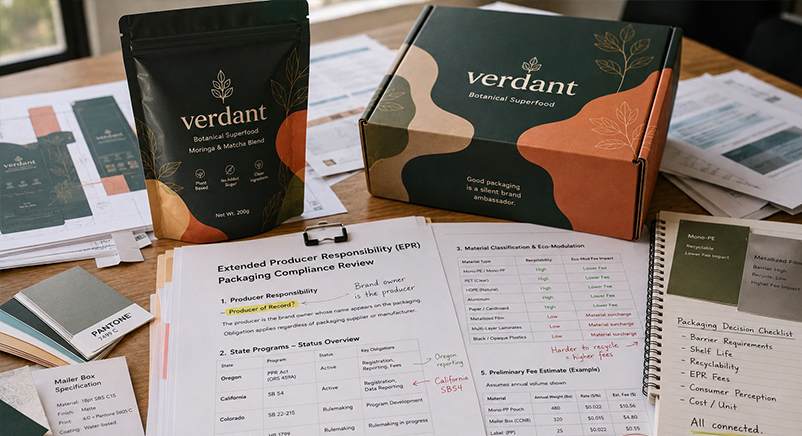
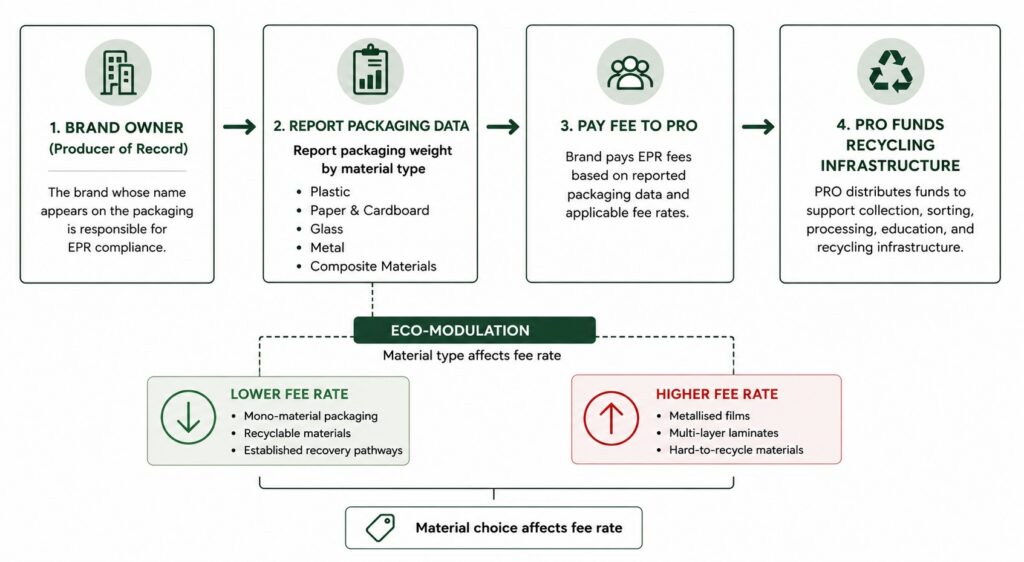
Extended Producer Responsibility shifts the cost of managing packaging waste from municipalities and taxpayers to the companies that put packaging into the market. In practice, this means brand owners register with a state program, join or pay into a Producer Responsibility Organization (PRO), report how much packaging they sell into a state by material type and weight, and pay fees based on that packaging’s recyclability and environmental impact.
The key word is “producer.” In US EPR packaging laws, the producer is almost always defined as the brand owner — the company whose name appears on the packaging. Not the company that made the pouch, printed the box, or applied the label. If you are the brand, you are the producer of record, and the compliance obligation is yours regardless of how many vendors are in your supply chain.
Fees are typically eco-modulated, meaning the rate you pay is adjusted based on whether your packaging is easy or hard to recycle. Packaging made from widely accepted materials — clear PET, natural HDPE, aluminum, paper — generally attracts lower fees than packaging made from hard-to-recycle formats like metallised flexible films, multilayer laminates, or opaque or coloured plastics with limited recovery infrastructure.
Which States Have Active EPR Packaging Laws Right Now
As of 2026, two states have EPR packaging programs in active implementation with obligations that apply to brand owners now. Three more are in rulemaking or pre-enforcement phases and will require action within the next one to three years. The distinction matters: active implementation means registration, reporting, and fee obligations are live. Rulemaking means the law exists but the program machinery is not yet operational.
Oregon — Plastic Pollution and Recycling Modernization Act (PPR Act)
Oregon’s PPR Act (ORS Chapter 459A) is the most operationally advanced US packaging EPR program. The Circular Action Alliance (CAA) is the PRO designated to administer it. Producer registration opened in 2025, and brands selling covered packaged goods into Oregon are required to register if their annual gross revenue exceeds $1 million and their packaging meets the covered materials criteria.
Covered materials under the PPR Act include plastic packaging of all types, paper and cardboard packaging, glass, metal, and composite formats. The $1 million revenue threshold provides a small-brand exemption — but it applies to the brand’s total annual revenue, not Oregon-specific sales. A coffee brand doing $1.2 million nationally that sells some product into Oregon is above the threshold and is required to register.
Fee schedules under Oregon’s program are based on packaging weight by material category. Eco-modulation applies: packaging that meets Oregon’s recyclability criteria attracts standard rates; packaging that does not — including most metallised flexible films, multilayer laminates, and packaging made from materials with no established Oregon recovery pathway — attracts a surcharge. The exact multiplier depends on the material category and the PRO’s annual fee schedule, which is published by CAA and updated periodically.
California — SB 54 (Plastic Pollution Prevention and Packaging Producer Responsibility Act)
California’s SB 54 is the larger and more complex of the two active programs. It applies to single-use packaging and single-use food service ware sold in California. The compliance timeline runs from 2025 through 2032, with milestones increasing the recyclability and recycled content requirements for covered packaging over time.
The key 2025–2026 obligations under SB 54 centre on producer registration and the first round of packaging data reporting. CalRecycle oversees the program. Brands that sell into California and meet the producer definition — which is broad, covering any entity that manufactures, imports, or distributes covered packaging — are required to register and begin submitting packaging data.
SB 54 also imposes source reduction requirements: by 2032, covered producers must collectively reduce plastic packaging by 25% and ensure 65% of plastic packaging is recyclable or compostable. The 2025–2026 compliance steps are registration and reporting — but the spec implications of the 2032 requirements are relevant now, because brands choosing new packaging formats today are choosing formats they will live with through the peak of the SB 54 compliance curve.
States in Rulemaking — Watch but Do Not Act Yet
Colorado’s SB 22-215 established an EPR framework and funded a statewide recycling needs assessment, but its producer registration program is still in development as of 2026. Washington and New York have advanced legislative proposals that are likely to pass but have not yet reached operational implementation. Brands selling into these states should monitor program timelines but do not face active registration or reporting obligations in 2025–2026.
Does EPR Apply to Your Brand — The Producer of Record Question
The producer of record determination is the first step, and it catches more brands off guard than the fees do. Most small brand owners assume that because they use a contract manufacturer, co-packer, or third-party converter, the EPR obligation passes to one of those parties. It does not. The obligation sits with whoever owns the brand — the entity whose name and trademark appear on the packaging.
There are edge cases. If you are a private-label brand selling under a retailer’s own brand, the retailer may be the producer of record. If you import a product manufactured overseas under your brand name, you are the importer of record and the EPR producer. If you sell through a marketplace and the marketplace has taken on producer responsibility obligations through a PRO agreement, you may be partially covered — but you cannot assume this without confirming it in writing.
For most small consumer brands — a founder-led coffee company, a DTC pet treats brand, a craft beverage producer — the answer is straightforward: if it is your brand, it is your EPR obligation. The question then becomes whether you are above the revenue threshold in Oregon, whether you sell into California, and whether your packaging falls within the covered materials categories in each state.
What You Are Required to Do and When
The practical compliance steps for most small brands break down into three phases: registration, data collection, and fee payment. The sequence matters — you cannot pay fees accurately without collecting data, and you cannot collect data without knowing what your reporting categories are, which requires registration first.
Step 1 — Register as a Producer
For Oregon, registration is through the Circular Action Alliance producer registration portal. You will need your business legal name, EIN, principal place of business, a contact for compliance correspondence, and a description of the covered materials your packaging contains. Registration in Oregon is required before the first annual reporting deadline.
For California, registration is through CalRecycle’s producer responsibility program. The registration process requires similar business identification information plus a declaration of your packaging portfolio — the categories of single-use packaging you place on the California market.
Step 2 — Collect Packaging Data
Annual reporting in both states requires packaging data at the material and component level. You need the weight of each packaging component — primary packaging (the pouch, the box, the label), secondary packaging (the shipper, the insert), and in some cases tertiary packaging — broken down by material type. Material types that require separate reporting typically include plastic by resin code (PET, HDPE, PP, LDPE, other), paper and cardboard, glass, aluminum and steel, and composite or multilayer formats.
If you order packaging from a supplier, your supplier can provide component weights — it is standard information on a specification sheet. The piece most brands are missing is not the data itself but a system for capturing and organising it by SKU. A spreadsheet tracking each SKU’s packaging components, materials, and weights per unit sold into each state is the minimum viable data infrastructure for EPR compliance at this scale.
Step 3 — Pay Fees
Fees are calculated based on the weight of covered packaging you report selling into a state during the reporting year, adjusted by the eco-modulation factors for each material category. For a small brand selling under 1 tonne of packaging per year — which is most brands in our ICP at their current scale — absolute fee exposure under current schedules is likely in the range of $500 to $2,000 per year per state. The bigger near-term financial risk is not the fees themselves but the penalties for non-registration or late reporting, which can be significantly higher than the fees avoided.
How Your Packaging Choices Affect What You Owe
Eco-modulation is the mechanism that connects your packaging spec decisions to your EPR fee exposure. It is also the part of EPR that is most directly relevant to decisions you are making right now — because the packaging you are ordering today is the packaging you will be reporting on and paying fees for in 2025 and 2026.
The basic principle: packaging that is easier to recycle attracts lower fees; packaging that is hard to recycle attracts a surcharge. In practice, this means the following material distinctions matter for fee exposure under current state schedules.
Lower fee exposure: Mono-material flexible films (mono-PE, mono-PP pouches), clear PET, natural HDPE, aluminum, uncoated paper and cardboard, glass. These materials have established recovery pathways and high acceptance rates at materials recovery facilities (MRFs).
Higher fee exposure: Metallised flexible films (common in coffee and snack packaging), multilayer laminates combining plastic and foil or plastic and paper, opaque or black plastics, PVC, and composite formats with no viable separation pathway. These materials either contaminate recycling streams or have no recovery infrastructure in most US markets.
The practical trade-off for a brand currently using a metallised stand-up pouch — a common format in coffee, supplements, and pet treats — is this: the material performs well for barrier protection and shelf life, but it carries higher eco-modulated fee exposure in California and Oregon. Switching to a mono-material PE or PP pouch reduces that fee exposure, but the switch has costs: new artwork setup, potential changes to fill and seal settings at your co-packer, and a qualification run to confirm the new material performs at your production speed and fill weight.
At low packaging volumes — under approximately 500kg of flexible packaging per year — the EPR fee difference between a metallised and a mono-material pouch is unlikely to justify a format change on cost grounds alone. Above that threshold, and particularly for brands selling into both California and Oregon simultaneously, the fee differential becomes meaningful enough to factor into the next packaging reorder decision. The stand-up pouch options on the Packaging Studio platform include both metallised and mono-material formats — if you are at the point of reordering or redesigning, it is worth reviewing which film structure your current spec uses and whether a switch is viable at your fill and seal setup.
For brands evaluating film options more broadly, the decisions around barrier layers, material structure, and co-packer compatibility are covered in more depth in Pouch Materials: How to Choose the Right Film for Your Product.
The Minimum Steps a Small Brand Needs to Take Now
If you sell packaged consumer goods and your annual revenue is above $1 million, the following applies regardless of how small your packaging operation feels relative to larger producers in the EPR conversation.
If you sell into Oregon and your revenue exceeds $1M: Check whether your packaging categories fall within the PPR Act’s covered materials list, then register with the Circular Action Alliance. Registration is the first obligation — it precedes reporting and fees. Brands that have not registered are not in a position to report accurately, and late registration carries penalties.
If you sell into California: Register with CalRecycle under SB 54 and begin collecting packaging data at the SKU and component level. The 2025–2026 obligation is registration and first-round data reporting. The 2032 recyclability requirements are further out, but the packaging decisions you make between now and then — particularly around plastic format and recycled content — will determine how much adaptation your portfolio needs before the later milestones hit.
If you sell into both states: Oregon and California use different PROs and different reporting schemas. Managing both adds administrative overhead. The data collection infrastructure is largely the same — SKU-level component weights by material — but the registration portals, fee schedules, and reporting timelines are separate. Build your data model to capture what both states need simultaneously rather than building it twice.
If your packaging volume is under 1 tonne per year: Your fee exposure under current schedules is manageable — likely under $2,000 per year per active state. The risk worth prioritising is non-registration, not fee optimisation. Get registered, get your data collection in order, and revisit material choices at your next packaging reorder rather than making a disruptive switch purely for fee reduction at current volumes.
If you are below the $1M Oregon threshold but approaching it: Build the data infrastructure now, before you cross the threshold. Retroactive data collection is significantly harder than collecting it as a standard part of each packaging order. A basic SKU-level packaging weight log — maintained as part of your supplier documentation — is all you need at this stage.
EPR compliance is not yet the kind of regulatory requirement that shuts down a brand overnight for non-compliance in the way that, say, a food safety violation might. But the programs are maturing, enforcement is increasing, and the brands that are furthest behind are the ones that treated EPR as a large-company problem. It is not. The producer definition in both Oregon and California is deliberately broad, and the compliance obligation follows the brand, not the balance sheet.
If you are reviewing your packaging spec and want to understand which formats carry lower eco-modulated fee exposure under current state schedules, the layflat pouch and stand-up pouch options on the platform are a practical starting point for brands currently using metallised or multilayer flexible packaging.
What you should read next
Ron Perry
Print Solutions Engineer, Packaging Studio
Ron Perry is Print Solutions Engineer at Packaging Studio, with 23+ years’ experience in commercial print, packaging production, and technical print setup. He focuses on the practical details that make packaging production-ready, including artwork specifications, print processes, labelling requirements, material constraints, and compliance checks. His compliance posts help businesses understand what needs to be considered before packaging artwork goes to print.