
Kraft, Clear, Foil or Compostable: Which Pouch Material Is Right for Your Product?

By
••
7 min read
•Understanding Packaging
Most brands pick a pouch material based on how it looks in a mock-up. That works fine — until the product arrives at a co-packer who can’t run the film, or until shelf life complaints come in three months after launch.
The material affects barrier performance, seal compatibility, and cost at scale. The aesthetic is secondary.
Kraft, clear, foil, and compostable are the four materials you’ll encounter most often when ordering custom pouches. They are not interchangeable. Each has a specific set of conditions where it works well and conditions where it fails.
What Each Material Actually Does
Before comparing them, it helps to understand what these materials are at a structural level — because the names can be misleading.
Kraft is a paper-based outer layer, typically laminated with a plastic or foil inner layer. The kraft layer gives you the matte brown appearance. The barrier performance depends on what it’s laminated with — kraft alone provides almost no protection against oxygen or moisture.
Clear film is typically BOPP (biaxially oriented polypropylene) or PET (polyester). It’s fully transparent, lightweight, and the lowest cost option. The barrier is limited — it provides basic moisture resistance but does little against oxygen or light.
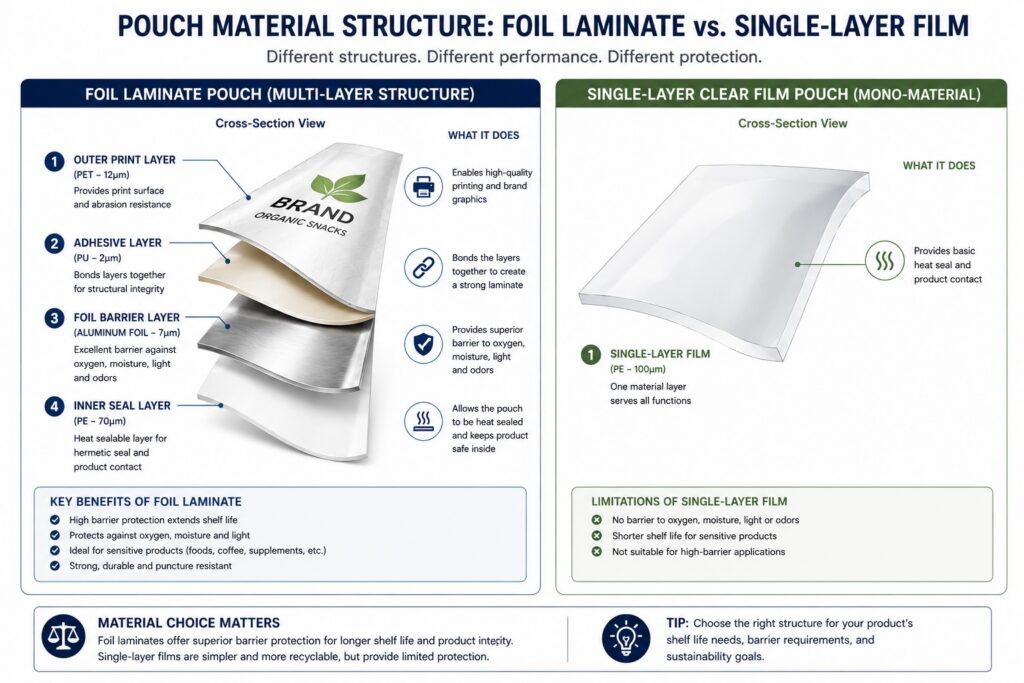
Foil refers to a metalized or aluminium foil laminate. The foil layer creates a physical barrier against oxygen, moisture, and light. It’s the most protective standard option and the default choice for products with shelf life requirements.
Compostable film is typically made from PLA (polylactic acid) or similar bio-based materials. It looks and handles similarly to standard clear or kraft film but is designed to break down under commercial composting conditions. The barrier is weaker than foil and the sealing behaviour differs from conventional films.
Barrier Performance: Where the Real Differences Are
The most important question for most products isn’t how the pouch looks — it’s how well it keeps the product stable over time. Barrier performance is what determines that.
Oxygen, moisture, and light are the three main threats. Different materials handle them differently.
Foil laminates provide the strongest barrier across all three. For products like coffee, dried herbs, supplements, and cannabis — anything where oxidation or moisture ingress affects flavour, potency, or safety — foil is the correct starting point. A properly laminated foil pouch can support 18–24 months shelf life for dry goods under standard storage conditions.
Kraft with a foil inner layer performs comparably to foil on barrier. The kraft outer layer is decorative and structural — it doesn’t change the barrier equation. Kraft with only a plastic inner layer performs closer to clear film: basic moisture resistance, limited oxygen barrier.
Clear film offers the weakest barrier of the four. BOPP provides reasonable moisture resistance for dry products that are not oxygen-sensitive, but it will not prevent oxidation in products like coffee or protect light-sensitive supplements. For a moisture-sensitive product in a clear pouch, expect visible degradation within 3–6 months.
Compostable film typically falls between clear film and foil on barrier performance. Certified compostable structures generally support 6–12 months shelf life for dry goods — adequate for products with fast inventory turns, but not for anything sitting in a retail environment for longer.
Cost Differences and Where They Come From
Material cost is one input into per-unit pricing, but it’s not always the dominant one. Understanding where the cost differences actually come from helps you evaluate whether the premium is justified.
Clear film is the cheapest option. At a typical MOQ of 250–500 units, clear BOPP or PET pouches run 5–15% less per unit than kraft equivalents in the same size. The material is simpler to produce and widely available.
Kraft sits slightly above clear on cost — the paper outer layer adds material cost and some complexity in lamination. The gap is modest at low volumes but worth accounting for across large SKU counts.
Foil laminates typically run higher than both kraft and clear. The cost premium reflects the foil layer itself and the more controlled lamination process required to maintain barrier integrity. For products that need foil, the premium is not optional — you’re paying for the shelf life, not just the appearance.
Compostable film carries the largest premium. At MOQs under 1,000 units, certified compostable structures run 20–40% higher per unit than standard foil laminates. The gap narrows at higher volumes but rarely disappears. Brands choosing compostable for cost reasons are generally making a category error — it is a higher-cost material, not a budget one.
Does Your Co-Packer Need to Approve the Material?
Yes — and this is the step most brands skip.
If you’re filling pouches on a vertical form fill seal (VFFS) line or through a co-packer that uses automated filling equipment, the pouch material affects how the line runs. Different films require different sealing temperatures, dwell times, and sometimes different tooling. A material that works well on one line may jam, seal inconsistently, or require calibration on another.
Compostable film is where this matters most. PLA-based films seal at lower temperatures than conventional PE or foil laminates. Lines calibrated for standard materials will often overseal compostable pouches, creating weak or compromised seals. Some co-packers will decline compostable film outright. Others will accommodate it but charge for the line reconfiguration.
The practical rule: before you commit to a material, share the film spec sheet with your co-packer and confirm they can run it without modification. This takes one conversation and prevents a significant amount of downstream pain.
For brands filling manually or at very small volumes, this constraint is less critical — but it becomes relevant the moment you move to a co-packer or scale production.
Which Material Is Right for Your Product?
The decision comes down to three variables: what the product needs to stay stable, what your production setup can run, and what volume makes the cost workable. Here’s how those variables resolve.
- If your product is oxygen- or light-sensitive — coffee, dried herbs, supplements, cannabis — choose foil. Clear and unlined kraft will not maintain product quality over a meaningful shelf life. This is not a preference; it’s a functional requirement.
- If shelf life under 12 months is acceptable and sustainability positioning matters — compostable is a viable choice. Confirm co-packer sealing compatibility before ordering. At under 1,000 units, budget 20–40% more per unit than foil equivalents.
- If the product is visually appealing and not light- or oxygen-sensitive — pet treats, some snacks, dried pasta — clear film works and is the most cost-effective option. The transparency can also be a feature if the product itself looks good.
- If you want a matte craft-market aesthetic with reliable barrier performance — specify kraft with foil inner lamination, not kraft with plastic only. Unlined kraft is appropriate only for products that don’t need meaningful barrier protection.
- If your co-packer runs high-speed VFFS — avoid compostable film until you’ve confirmed it runs on their specific line without adjustment. The risk is operational, not aesthetic.
The material decision and the format decision are closely linked. A flat bottom bag in foil laminate serves a different function than a clear layflat pouch for the same product. Once you’ve confirmed the right material, reviewing your stand-up pouch options or layflat pouch options alongside the material spec will help you arrive at a complete structure — not just a surface finish.
For a deeper look at how film layers interact with product requirements, the guide on choosing the right film for your product covers barrier ratings, lamination structures, and what to ask your supplier before confirming a spec.
Ecommerce is easy when you know how.
If you’re you need help our team can talk you through every aspect from design t delivery, before anything goes to print.

Pasha Hanover
Growth Marketer and Strategist, Packaging Studio
Pasha Hanover is a Growth Marketer and Content Strategist with 10+ years’ experience in performance marketing, brand positioning and customer acquisition. He focuses on how packaging influences buying behaviour, product perception, repeat purchase and brand loyalty. His posts help businesses understand where packaging fits into the wider customer journey and how it can support commercial growth.