
What Actually Influences Packaging Perception (And What Doesn’t)

By
••
7 min read
•Understanding Packaging
Most packaging upgrades get evaluated in the wrong order. Brands invest in tissue paper and ribbon pulls before fixing a box that’s visibly too large for the product inside.
The elements that form perception do so in seconds — before any deliberate evaluation starts. Customers don’t inspect your packaging and render a verdict. They register a handful of cues almost instantly, and the impression is already set before they’ve consciously thought about it.
Knowing which elements trigger those cues — and which ones only register after the impression is already formed — changes how you allocate a packaging budget at an early stage.
How Perception Actually Forms
The instinct is to think of packaging perception as something customers evaluate. They notice the finish, read the copy, feel the weight. In practice, the sequence is faster and less deliberate than that.
The first judgement happens on exterior cues alone: does this look like a considered product or an interim solution? That read comes from print quality, structural proportion, and surface finish — in roughly that order. It takes less than three seconds and happens before the customer has touched anything.
What customers notice next — once they’re holding it — is whether the structure fits the product. A box that’s too large for what’s inside signals that no one thought carefully about the packaging. It undermines the exterior impression even when the print is good.
Everything else — tissue, inserts, ribbon pulls, branded cards — is noticed deliberately, after the primary impression is already set. Those elements can reinforce a strong first read. They can’t rescue a weak one.
The Elements That Move Perception at an Early Stage
Not all packaging elements have equal return at low to mid volumes. These are the ones that register before any deliberate evaluation starts, ranked roughly by signal strength.
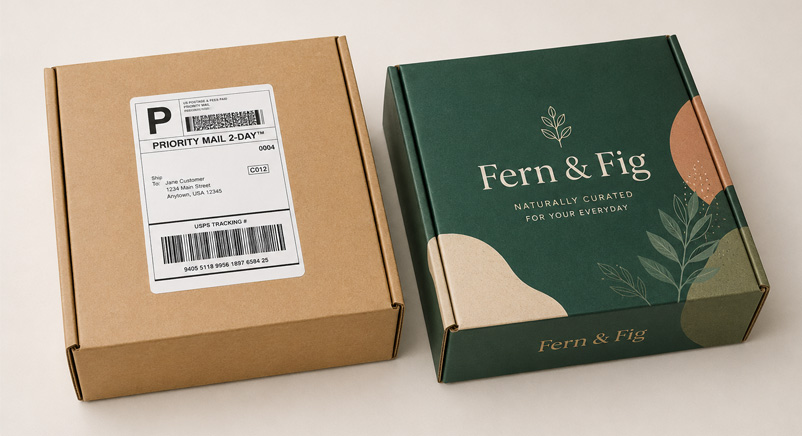
Print quality and coverage. The single largest perception driver is whether packaging is fully printed or carrying a label on a stock substrate. A fully printed stand-up pouch or mailer box signals brand investment immediately — the customer can’t miss it. A well-designed label on a stock bag reads as interim packaging, even when the label itself is executed well. At run sizes of 500–1,000 units, digital printing on a stand-up pouch typically adds $0.30–$0.80 per unit over label-on-stock. The perception gap is wider than the cost gap.
Surface finish. Matte laminate, soft-touch coating, and spot UV are noticed on first contact — before the box is opened. They communicate care and intentionality through touch, not sight, which makes them unusually powerful as perception signals. A soft-touch finish on an otherwise standard structure outperforms an unfinished premium format more often than brands expect.
Structural fit. If the product moves inside the box, the packaging reads as poorly considered regardless of what’s printed on the outside. Structural fit — the box actually being sized for the product — is noticed immediately and unconsciously. It’s one of the cheapest perception signals to get right and one of the most commonly neglected at early stage.
Exterior print hierarchy. On the front panel, how clearly the brand name, product name, and key descriptor are separated matters. Cluttered front panels where everything is the same visual weight make the product harder to read quickly. Clean hierarchy signals confidence. This is a design decision, not a material cost — but it’s part of what determines whether the exterior impression is strong.

The Elements That Don’t Move It Much Yet
These are the elements early-stage brands most commonly overspend on relative to the perception return they get.
Branded tissue and ribbon pulls. These are noticed — but only after the primary impression is already formed. In a strong unboxing sequence, they extend a good first read. In a weak one, they create a mismatch: elaborate interior packaging inside a box that didn’t fit well. Customers notice the contradiction more than they notice the tissue.
Premium inserts before structural fit. Custom foam, moulded pulp inserts, and compartmentalised trays are worth investing in when the product genuinely needs them for protection or presentation. Investing in them before the outer structure fits the product is a sequencing mistake. The insert is inside the box — the structural fit is the first thing registered.
Inner box colours and liner prints. Branded inner surfaces and coloured liners are a meaningful detail in a mature packaging system. At early stage, they register as a nice surprise rather than a perception driver. They don’t move the primary impression that forms before the box is opened.
None of these elements are wrong to invest in. The issue is order of operations. Brands that sequence their packaging investment correctly — exterior print first, structural fit second, surface finish third, interior details when ready — get more perception return per dollar at early stage than brands that invest across all elements simultaneously at lower quality.
The Trade-offs Worth Understanding
Full-coverage print vs label-on-stock. The label approach is lower cost and more flexible — you can update copy, regulatory text, or design without scrapping printed inventory. The trade-off is a persistent perception ceiling. Once customers have seen fully printed packaging in the same category, the label-on-stock alternative reads as earlier-stage regardless of how good the label is. The upgrade to full print is worth making once you have a stable design and predictable reorder volume — not necessarily at first launch.
Finish upgrade vs format change. Upgrading the surface finish on your current format — adding soft-touch laminate to a mailer box you’re already using — is a lower-cost perception improvement than switching to a different structural format entirely. Rigid boxes, for example, carry a 3–5x unit cost premium over standard mailer boxes. They perform well on perception — but so does a well-finished mailer box at a fraction of the cost. The format question is worth revisiting at higher volumes when the economics shift.
Structural fit vs premium inserts. A product that fits cleanly inside a box with no void fill and no movement outperforms a product packed in tissue inside an oversized box on every unconscious perception cue. Fit is a structural decision that costs nothing extra if it’s built into the initial spec. Inserts cost per unit. Sequence accordingly.
A Decision Framework for Early-Stage Packaging
If your per-unit packaging budget is under $1.00 and you’re choosing one upgrade, invest in full-coverage print over labels. It’s the element that shifts perception before the customer touches the product.
If you’re deciding between a finish upgrade and a format change, start with the finish upgrade on the format you’re already using. Format changes are a larger cost commitment with uncertain perception return until volume justifies the economics.
If you’re tempted to invest in branded inserts and tissue before your structural fit is right, fix the fit first. A well-fitted plain box outperforms a poorly fitted premium one on the cues that form first.
If you sell primarily through ecommerce, weight your investment toward exterior print and the opening sequence — those are the moments that form perception when there’s no retail shelf context. If you’re moving into retail, front panel clarity and structural distinctiveness matter more.
If you’re pre-500 units per run, digital printing makes full-coverage print accessible without the MOQs that offset or flexo printing require. This is the stage where the upgrade from label to full print has the highest relative perception return because the cost difference is smallest.
Where to Start
For most early-stage brands, the right sequence is: get the structure right for the product, get the exterior fully printed, then add finish and interior detail as volume and margin allow.
That sequence isn’t about spending less — it’s about spending in the order that delivers the most perception return at each stage. The brands that get this right don’t necessarily have the most elaborate packaging. They have packaging where the highest-signal elements are done well.
If you’re at the point of choosing between formats — mailer box, stand-up pouch, product box — it helps to look at the structural and print options side by side before committing to a direction. Custom stand-up pouches and custom mailer boxes are the two most common starting points for early-stage brands moving from label-on-stock to fully printed packaging, and the perception return on that upgrade is typically the clearest place to start. For a deeper look at where unboxing investment pays back in retention, What Makes an Unboxing Experience Worth the Cost covers the sequencing in more detail.
What you should read next

Brad Holmes
Designer & Strategist, Packaging Studio
Brad Holmes is Designer and Strategist at Packaging Studio, with 20+ years’ experience developing creative and technical work for print. His background spans wide format, commercial print, direct-to-customer print, and packaging. His guides focus on the decisions that shape how packaging works in the real world, from presentation and usability to production requirements and customer experience.