
MOQ for Custom Pouches: What to Expect at Low Volumes

By
••
5 min read
•Understanding Packaging
Most pouch suppliers quote minimums that assume you already have a scaled brand. The reality for a first or second order is different — and it matters whether you understand the cost difference before you commit to a run size you’ll regret either way.
Low-volume custom pouch orders are genuinely available today in a way they weren’t five years ago. But accessible doesn’t mean cheap, and cheap doesn’t mean the right call. The number of units matters less than what you’re giving up — or gaining — at each volume level.
What MOQs for Custom Pouches Actually Look Like Today
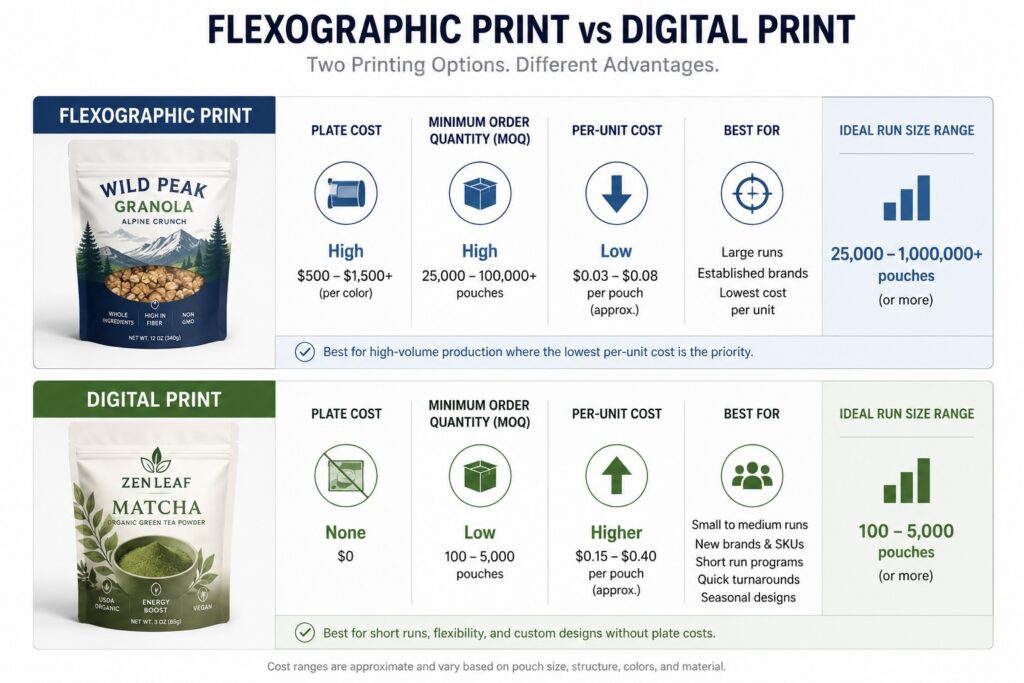
The traditional packaging supply chain was built around large runs. Flexographic printing — the dominant method for pouches at scale — requires physical plates that cost $800–$2,000+ to set up per design. That plate cost has to be recovered somewhere, which is why minimums of 5,000–10,000 units were standard for fully printed flexible packaging until recently.
Digital printing changed the economics at the low end. Because there are no plates, the setup cost is effectively zero per design. That means suppliers running HP Indigo and similar digital presses can offer minimum order quantities of 250–500 units without the unit economics falling apart on their end.
In practice, the accessible MOQ range for digitally printed custom pouches today is 250–500 units for a first order, with most platforms targeting 500 units as a clean starting point. Below 250 units, the economics typically break down — even for digital print — because the fixed costs of production scheduling, quality checks, and shipping don’t scale down proportionally with unit count.
Why Per-Unit Cost Rises Sharply at Low Volumes
The MOQ being 250 units does not mean 250 units is cheap. It means 250 units is possible. Those are different things.
Per-unit cost for a digitally printed custom stand-up pouch at 250 units typically falls in the $1.50–$3.00+ range depending on pouch size, barrier specification, and finish. At 1,000 units, the same spec usually lands closer to $0.80–$1.50 per unit. At 2,000+ units, you’re looking at further reductions, though the curve flattens — the biggest drop happens between 250 and 1,000.
To make that concrete: a brand ordering 500 pouches at $2.50 each spends $1,250 on packaging. The same brand ordering 1,500 units of the same spec at $1.20 per unit spends $1,800 total — but has three times the stock and a meaningfully lower cost per unit. Whether $550 more up front is worth three times the inventory depends entirely on how fast you’re selling through.
The cost difference is real and does not disappear. What changes is whether that premium is justified by where you are in your brand’s development — not whether it’s avoidable.
What Low-Volume Orders Get Right — and What They Don’t
Low-volume digital print delivers something that generic stock bags with applied labels do not: a fully branded pouch. The print quality from a well-run digital press — colour accuracy, fine text, gradient handling — is comparable to flexographic output for most applications. The constraint is cost and scalability, not capability.
What low-volume orders don’t solve is unit economics for a brand that is already selling at meaningful volume. If you’re consistently moving 500+ units per month and reordering regularly, the per-unit premium at 500-unit runs is compounding against you every cycle. That’s the point at which stepping up to 1,000–1,500 unit runs pays for itself quickly.
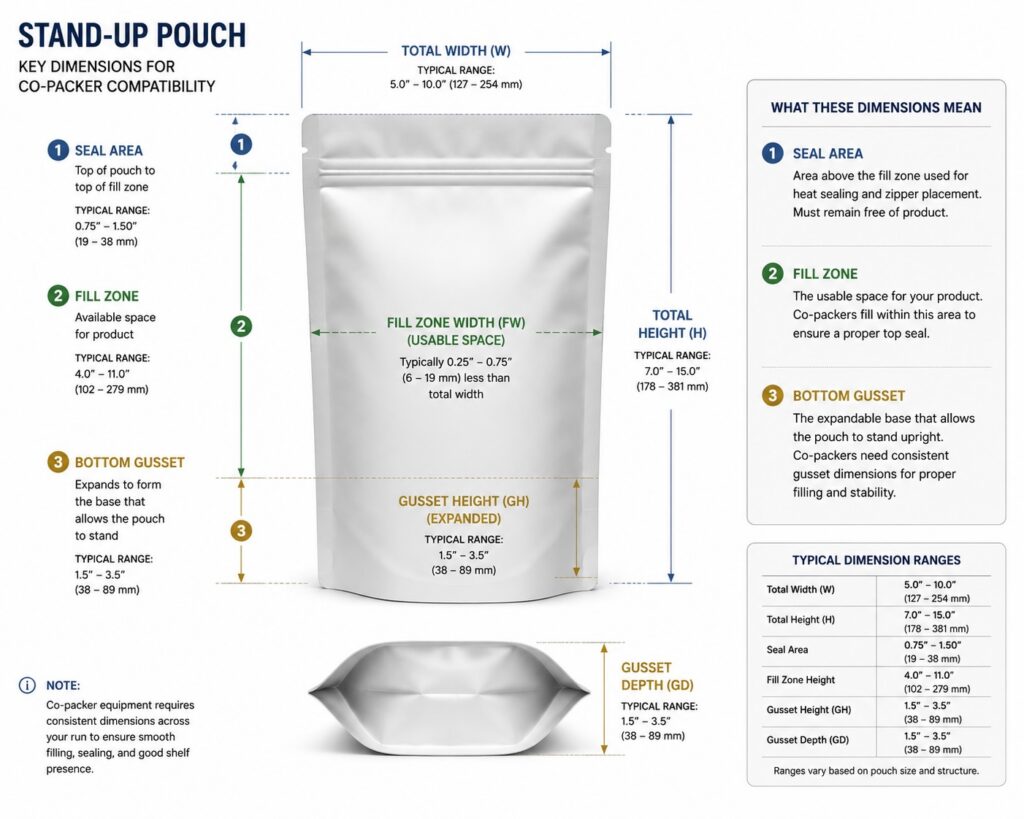
There is also a format and spec consideration that many founders miss at the ordering stage. Not every pouch format runs cleanly on every production line. If you work with a co-manufacturer or co-packer, their filling and sealing equipment has specific requirements — fill jaw width, bottom gusset depth, seal area dimensions. A pouch ordered without confirming these specs can arrive and be unusable on their line. This is one of the more avoidable costs in early packaging, and it is entirely separate from MOQ.
For reference, custom stand-up pouches and custom layflat pouches each have different spec ranges — size, barrier film, seal configuration — and the right choice depends on your product, fill process, and channel before it depends on your budget.
When to Order at Low MOQ — and When to Wait
The right volume to order is not always the lowest available. These rules resolve the most common scenarios:
- If you are under 500 units per month and have not yet validated sales velocity — order at low MOQ (250–500 units). The higher per-unit cost is the cost of market validation. Absorb it rather than tying $3,000–$5,000 in inventory to a product and channel you haven’t fully proven.
- If you are consistently selling through 500+ units per month and reordering three or more times per year — step up to 1,000–1,500 unit runs. At that volume and frequency, the per-unit savings compound quickly. The total spend goes up modestly; the per-unit cost drops meaningfully.
- If your co-packer or co-manufacturer has specific equipment requirements — confirm spec compatibility before placing any order regardless of MOQ. A format incompatibility discovered after the pouches arrive is a sunk cost that cannot be recovered by reordering faster.
- If budget is the primary constraint but you need branded packaging — low-volume digital print at 250–500 units is preferable to generic stock bags with labels. The per-unit premium is real; the brand outcome is categorically different. The question is whether your product price point can absorb the packaging cost at that volume.
The decision is rarely about finding the lowest MOQ available. It is about matching your run size to your current sell-through rate and cash position — and knowing that the cost curve will reward you as your volume grows.
If you’re at the stage of working out what pouch format makes sense for your product before thinking through run size, the pouch materials guide covers how film specification affects cost, barrier performance, and format choice — useful context before committing to a spec.

Pasha Hanover
Growth Marketer and Strategist, Packaging Studio
Pasha Hanover is a Growth Marketer and Content Strategist with 10+ years’ experience in performance marketing, brand positioning and customer acquisition. He focuses on how packaging influences buying behaviour, product perception, repeat purchase and brand loyalty. His posts help businesses understand where packaging fits into the wider customer journey and how it can support commercial growth.