
What Ecommerce Packaging Really Costs (It’s Not the Unit Price)

By
••
7 min read
•Industry Insights
Most brands choose packaging by comparing unit prices. That number is real — but it’s usually the smallest cost in the decision.
The charges that move P&L are DIM weight, damage rate, and the cost of getting the spec wrong and reordering. None of those appear on a packaging quote.
If you’re mid-way through a packaging decision and unit price is your primary filter, this is worth reading before you place the order.
Why Unit Price Is the Wrong Starting Point
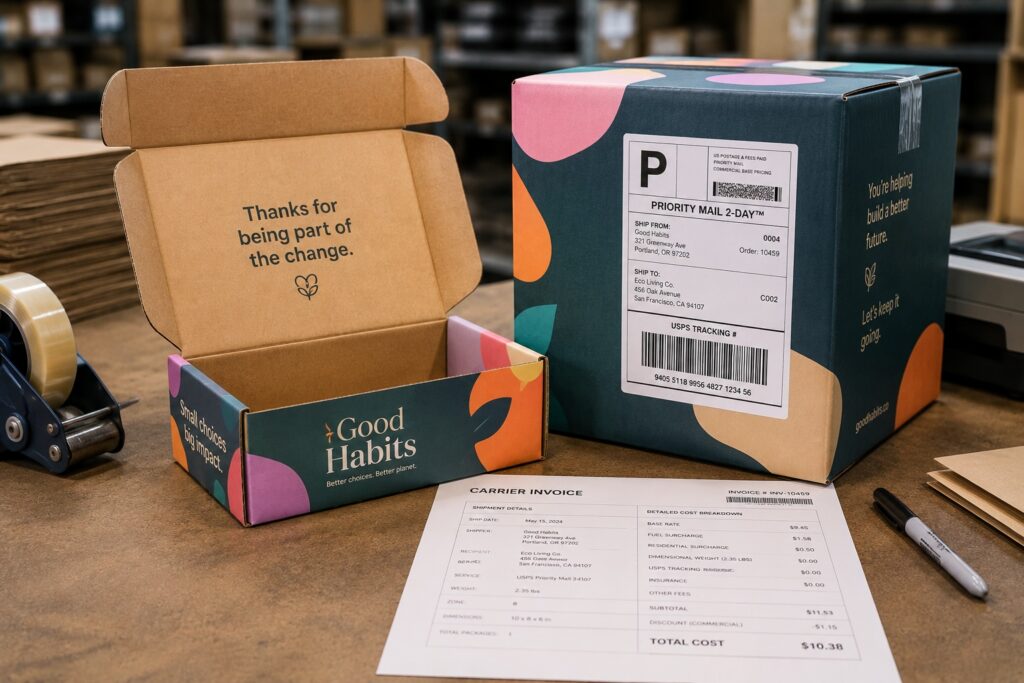
Unit price is visible, comparable, and easy to put in a spreadsheet. That’s why it becomes the default lens. But it measures only what you pay the packaging supplier — not what you pay to ship the box, replace damaged orders, or restart the process when the spec turns out to be wrong.
For most ecommerce brands at low to mid volume, the per-unit packaging cost sits somewhere between $0.80 and $3.50 depending on format and quantity. That range matters. But the costs below it — the ones that compound monthly and don’t show up until the carrier invoice or the customer service queue — often run higher over a quarter than the unit price saving ever recovers.
There are three cost categories worth understanding before the next packaging decision gets made on price alone.
DIM Weight: The Cost That Arrives After the Order
Dimensional weight (DIM weight) is how carriers price packages that are large relative to their actual weight. The formula for domestic ground shipping is length × width × height (in inches) divided by 139. If the result is higher than the actual package weight, the carrier bills on DIM weight — not actual weight.
A mailer box that measures 14 × 10 × 4 inches has a DIM weight of 4.03 lbs. If the product inside weighs 1.5 lbs, the shipment bills at 4 lbs. On a Zone 5 ground shipment, that gap costs roughly $1.80–$2.50 extra per package depending on carrier and negotiated rates.
At 300 orders per month, a box with 2.5 inches of unnecessary void space on each side adds $540–$750 per month in avoidable carrier charges. The packaging itself may have been $0.40 cheaper per unit than the fitted alternative — a saving of $120/month against a DIM weight overage of $600+.
The fix is to measure the actual packed dimensions of the product before choosing a box size, not after. A box that fits the product closely — typically with no more than 1 inch of clearance per side for standard protective fill — eliminates most of this exposure. If your current box leaves more than 2 inches of void on any side, the DIM weight impact is worth calculating before assuming it’s the cost-efficient option.
Damage Rate: What a 2–3% Breakage Number Actually Costs
A 2–3% damage rate sounds like a minor operational issue. In practice it’s a compounding cost that most brands don’t fully account for until they run the numbers.
At 500 orders per month with a 3% damage rate, 15 shipments arrive damaged each month. Each damaged shipment typically involves replacement product at cost, outbound re-shipping (often expedited), return label or disposal, and customer service time. Conservatively, each incident costs $12–$25 all in depending on product value and weight.
That’s $180–$375 per month in damage-related costs — from a 3% rate that most brands quietly absorb as a normal cost of doing business.
If better protective packaging — a fitted insert, a box with higher burst strength, additional void fill — costs $0.60 more per unit, it costs $300 extra per month at 500 orders. Against $180–$375 in damage costs, the economics are close to neutral at worst and clearly positive at best. And that calculation doesn’t include the harder-to-quantify costs: the review that follows a damaged order, the customer who doesn’t reorder, and the chargeback that occasionally results.
The threshold where protective packaging investment starts to pay is lower than most brands expect. A damage rate above 1.5% at any meaningful volume is worth investigating as a cost problem, not just a fulfilment problem.
Reorder Friction: The Cost of Getting the Spec Wrong
Getting the packaging spec wrong on the first order is common. The format doesn’t work with the co-packer’s line. The box is fractionally too small for the product with its retail insert. The dimensions trigger a DIM weight problem that wasn’t anticipated. These aren’t catastrophic failures — but they reset the process.
A packaging reorder triggered by a spec error typically means a new minimum order quantity against boxes that may already be in stock, artwork revisions if dimensions have changed, potential delays of 2–4 weeks on digital print runs, and the carrying cost of unusable inventory from the first order.
For brands ordering at 500–1,000 units per run, the cost of one spec-error reorder frequently runs $600–$1,500 when inventory waste, artwork time, and delay costs are included. That cost almost never appears in the initial packaging budget — and it’s entirely avoidable if the specification questions are resolved before the first order rather than after it.
The questions worth resolving upfront: what are the packed dimensions of the product including any inserts or tissue? Does a co-packer or fulfilment centre need to be consulted on box compatibility? Is the intended carrier’s DIM weight formula accounted for in the box size selection?
How to Compare Packaging Options on Total Cost
A more complete cost comparison runs four numbers rather than one:
Unit price — what the packaging supplier charges per box or pouch at your order quantity.
DIM weight exposure — calculate L × W × H / 139 for the packed shipment. If the result exceeds actual package weight, multiply the gap by your carrier rate per pound for the relevant zone. Multiply by monthly order volume.
Damage cost — take your current damage rate (or estimate 2% if unknown) multiplied by monthly orders. Multiply by your average all-in cost per damaged shipment (replacement + re-shipping + service time). This is your monthly damage liability.
Reorder risk — if the spec hasn’t been validated against your fulfilment process, factor in a reorder risk. One spec-error reorder amortised across 12 months adds a real per-unit cost to the first year’s supply.
Most brands that run this comparison find the gap between the cheapest option and the right option is smaller than the unit price difference suggested — and occasionally reverses entirely.
When the Cheaper Box Is the More Expensive Choice
The decision framework that comes out of this analysis is fairly direct:
- If your current box leaves more than 2 inches of void space on any side → calculate the DIM weight charge before treating it as the cost-efficient option. It frequently isn’t.
- If your damage rate is above 1.5% → the monthly cost of that rate likely exceeds what better protective packaging would add per unit. The investment case is there.
- If you’re reordering the same box more than three times per year → reorder friction and minimum quantity constraints are real costs worth factoring into the comparison.
- If unit price is your only filter → you are missing at least two cost components that will surface on your P&L within 90 days of shipping at volume.
None of this means unit price doesn’t matter — it does, and the difference between $1.20 and $2.10 per unit at 500 orders per month is $450/month that compounds over a year. The point is that unit price in isolation gives an incomplete picture, and the costs it leaves out are the ones that tend to be most controllable.
If you’re at the stage of comparing box formats and sizes, getting the dimensions right before ordering is where most of the real cost leverage sits. A custom mailer box sized to your actual packed product eliminates DIM weight exposure from the first shipment — and a custom shipping box built to your product’s dimensions does the same for transit-focused fulfilment. The unit price on a fitted box is occasionally higher; the total shipment cost is usually lower.
Ecommerce is easy when you know how.
If you’re you need help our team can talk you through every aspect from design t delivery, before anything goes to print.

Brad Holmes
Designer & Strategist, Packaging Studio
Brad Holmes is Designer and Strategist at Packaging Studio, with 20+ years’ experience developing creative and technical work for print. His background spans wide format, commercial print, direct-to-customer print, and packaging. His guides focus on the decisions that shape how packaging works in the real world, from presentation and usability to production requirements and customer experience.