
What Is Web-to-Pack — and Is It Right for Your Brand?

By
••
6 min read
•Industry Insights
Most brands discover web-to-pack the same way — a vendor uses the term and they’re not sure whether it means something genuinely new or just online ordering with a different name.
It does mean something different. Whether it applies to your brand depends on how you’re currently buying packaging and what that’s actually costing you.
Why Packaging Procurement Breaks Down for Small Brands
The traditional packaging supply chain was built for volume. Suppliers set minimum order quantities — typically 500 to 1,000 units per SKU — because their economics depend on long runs. Pricing is negotiated by phone or email. Lead times are quoted as ranges. Reordering means starting the conversation again.
For a brand running two or three SKUs and reordering three or four times a year, that process has real costs attached to it — time spent on back-and-forth, cash tied up in inventory you over-ordered to hit a minimum, and the friction of getting a quote before you can even compare options.
Most small brands absorb those costs without naming them. They’re the reason packaging feels harder to manage than it should be at this stage.
What Web-to-Pack Actually Is
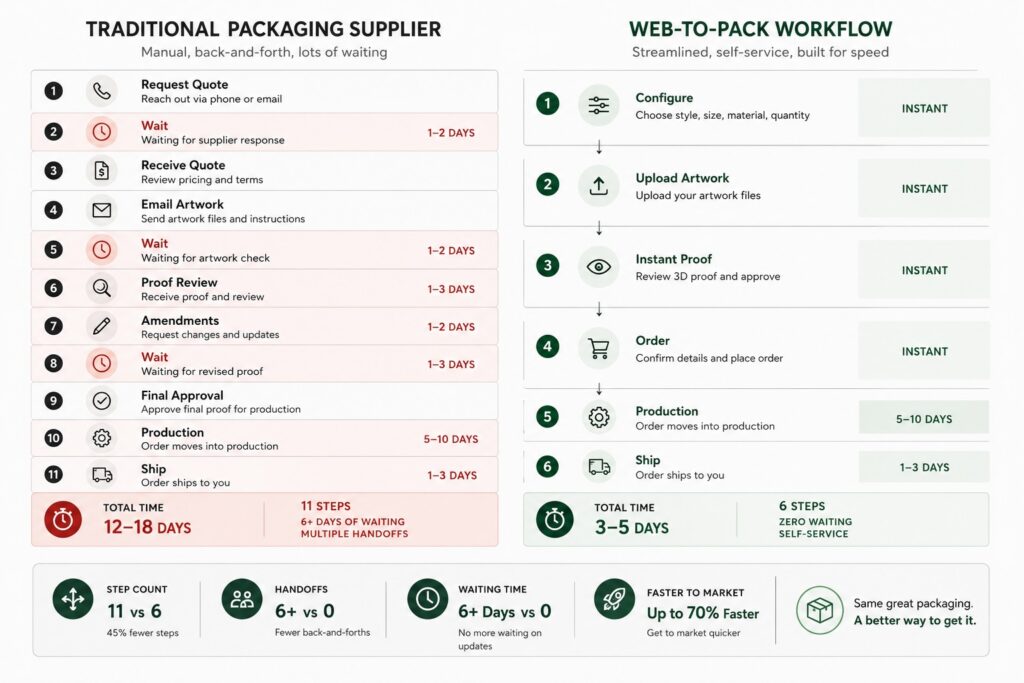
Web-to-pack is a procurement model that moves the entire packaging workflow online — configuration, pricing, artwork proofing, ordering, and reordering — without the intermediary layer of a sales rep or account manager.
The key difference from traditional online print ordering is that web-to-pack platforms are built specifically for packaging formats: structural considerations, material specifications, print constraints, and production routing are handled by the platform rather than requiring a specialist conversation every time.
In practice, that means you can configure a format, see real pricing, upload artwork, get a proof, and place an order without a phone call. The same process applies to a reorder six weeks later.
What Changes in Practice
Three things shift materially when a brand moves to a web-to-pack model.
Minimum order quantities drop. Web-to-pack platforms using digital print equipment can run orders from around 50 to 250 units depending on the format — compared to 500 to 1,000+ through traditional suppliers. That matters most for brands testing a new SKU, managing seasonal variants, or keeping inventory lean while demand is still unpredictable.
Turnaround becomes visible and predictable. Domestic web-to-pack production typically runs 5 to 10 business days from proof approval to shipment. Overseas direct suppliers generally quote 6 to 12 weeks. The gap is significant for any brand reordering frequently — and the domestic option removes the need to forecast 3 months ahead to avoid running out.
Reordering stops being a project. Because the artwork, specs, and supplier routing are already in the platform, a reorder is a repeat of a previous job — not a fresh quoting exercise. For brands placing 3 or more orders per year, that operational simplicity compounds quickly.
Who Web-to-Pack Is Actually Built For
Web-to-pack works best for brands that are placing regular orders across standard formats — boxes, pouches, mailers, labels — where the packaging decision has already been made and the operational question is how to buy it efficiently.
It’s most valuable when some combination of the following is true: you’re ordering multiple times per year, managing more than one SKU, dealing with the friction of re-quoting with a traditional supplier on every order, or currently over-buying to hit a minimum order quantity.
It’s less suited to brands with highly custom structural requirements — unusual die lines, bespoke substrate combinations, or packaging that requires significant engineering input on every order. Those projects still route through specialist suppliers where the relationship and technical depth justify the overhead.
For brands using a generic bag-and-label approach, web-to-pack is often the first step toward fully printed packaging — and the platform model makes that upgrade more accessible than going direct to a traditional supplier for the first time.
The Trade-offs Worth Knowing
Per-unit cost vs flexibility. At equivalent volumes, web-to-pack domestic production costs more per unit than overseas direct. At 100 units, the premium is real. At 500 units and above, with stable demand, the calculus shifts and a direct supplier relationship may be more cost-efficient. The question is whether the flexibility — lower minimums, faster turnaround, easier reorders — is worth the per-unit difference at your current volume.
Speed vs cost on turnaround. The 5–10 day domestic option carries a higher landed cost than a 6–12 week overseas run. For brands with predictable demand and long planning horizons, overseas can make sense. For brands reordering 3 or more times a year or managing unpredictable demand, the carrying cost of 12 weeks of inventory often closes the gap — and the operational simplicity of domestic reordering has its own value.
Platform range vs custom capability. Most web-to-pack platforms cover a defined set of standard formats and materials well. If your packaging requirements sit outside those parameters — unusual structures, speciality finishes, formats the platform doesn’t support — you’ll hit the ceiling quickly. It’s worth confirming format compatibility before committing to a platform-first approach.
Is Web-to-Pack Right for Your Brand?
The answer depends on where the friction in your current process actually sits.
- If you order packaging fewer than 3 times per year at stable volumes above 500 units → a traditional supplier relationship is likely more cost-efficient; the flexibility premium of web-to-pack is harder to justify at that cadence.
- If you’re reordering frequently, managing multiple SKUs, or testing new formats → the turnaround speed and low MOQ flexibility of web-to-pack typically outweigh the per-unit cost difference.
- If you currently use a regional print shop with no online ordering, no real-time pricing, and no visibility until you call → web-to-pack almost certainly offers a better operational experience at comparable or lower total cost.
- If your packaging involves unusual structures or substrates not covered by standard platform formats → confirm compatibility before assuming the model applies.
The brands that get the most out of web-to-pack are the ones that were already absorbing the hidden costs of the traditional model — over-ordering to hit minimums, losing weeks to reorder friction, re-quoting the same job every cycle. The platform doesn’t eliminate trade-offs; it makes them visible and manageable.
If you’re at the stage of comparing formats or materials for the first time, custom stand-up pouches and custom mailer boxes are two of the most common entry points — both available with real-time pricing and no minimum order conversation required.
What you should read next
Tom Moriarty
General Manager, Packaging Studio
Tom Moriarty is General Manager at Packaging Studio, with 15+ years’ experience across commercial print and packaging. He has worked closely with brands, suppliers, and production teams, giving him a practical view of how the industry is changing and what those changes mean for businesses. His industry insights focus on trends, challenges, and commercial shifts that affect packaging decisions in the real world.