
Holiday Packaging: How to Plan, Order, and Get It Right

By
••
8 min read
•Industry Insights
October is when holiday packaging orders should be confirmed. It’s also when most brands are still finalising artwork.
That gap — between when the order needs to go in and when the design is actually ready — is where holiday packaging plans fall apart. Not from lack of intention, but from a sequencing problem: the designer gets briefed before the format is confirmed, the format gets confirmed before lead times are checked, and by the time everything is aligned, the production window is tight or gone.
What follows covers the lead times, format decisions, and quantity planning that keep the season workable — and the order of decisions that most brands get backwards.
Why Holiday Lead Times Are Longer Than You Expect
Standard production times at Packaging Studio run 8–10 business days for most formats. That number is accurate for most of the year. In September and October it stops being reliable.
Supplier capacity compresses as Q4 approaches. Brands that ordered comfortably in Q2 and Q3 with 10-day turnarounds find themselves looking at 3–4 week lead times for the same formats in October — not because anything changed about the production process, but because everyone is placing holiday orders at the same time.
The practical implication: if your peak selling window starts in late November, your order needs to be placed by mid-October at the latest to have confidence in the timeline. For brands with a co-packer in the chain, add another week — co-packer schedules fill up independently of yours, and packaging that arrives late holds up the whole production run.
Lead times by format as a planning baseline:
- Custom pouches (stand-up, layflat): 10 business days standard; allow 3–4 weeks in October
- Custom mailer boxes and product boxes: 8 business days standard; allow 3 weeks in October
- Custom shipping boxes: 10 business days standard; allow 3–4 weeks in October
- Labels: 10 business days standard; the most flexible format under time pressure
These are planning baselines, not guarantees. The earlier you confirm your spec and place the order, the more buffer you have against delays at any point in the chain.
Custom Print vs Seasonal Labels: The Core Format Decision
The most common holiday packaging decision is also the one brands make last: whether to invest in fully custom printed packaging for the season, or to run seasonal labels on existing stock.
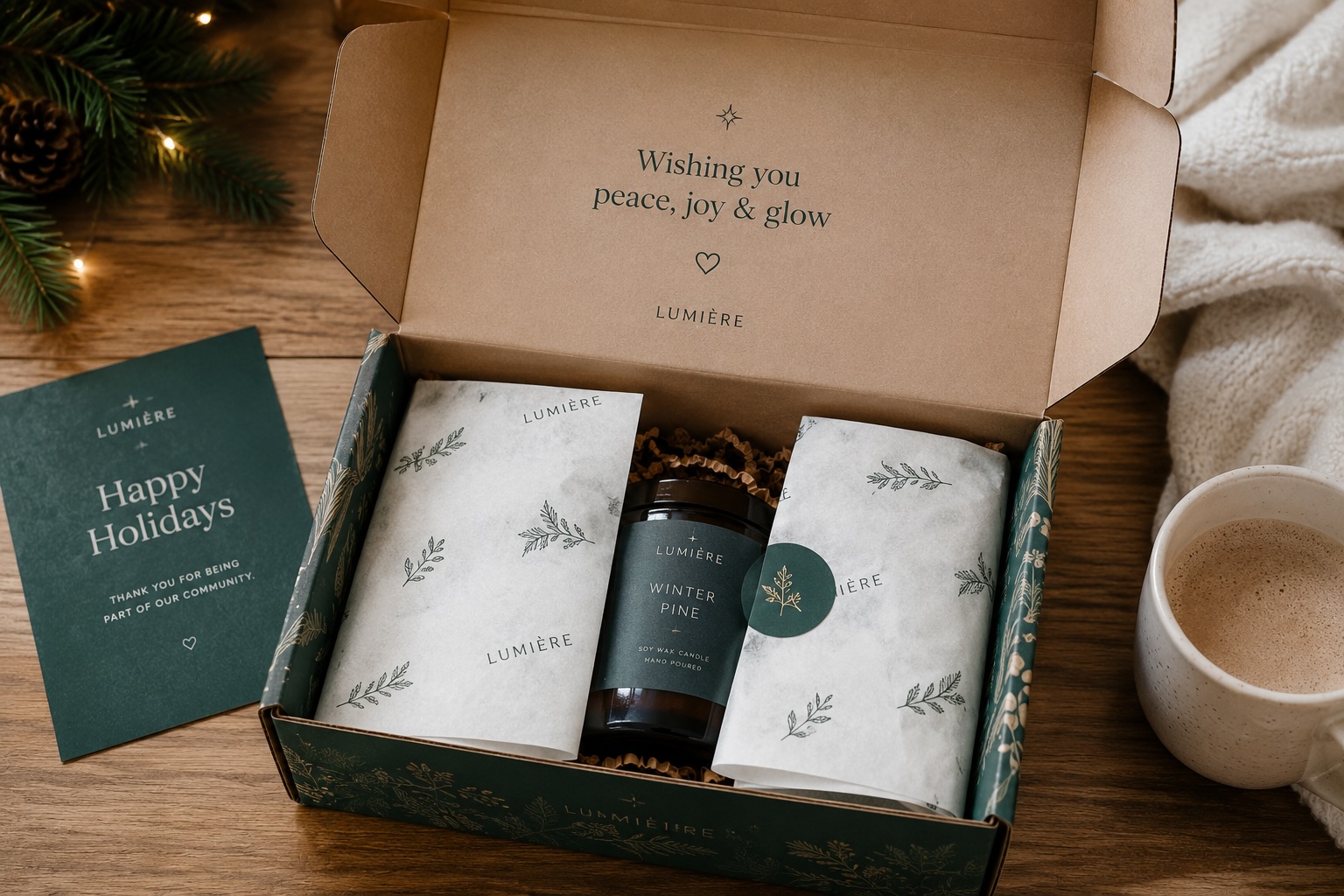
Custom printed packaging — a pouch, mailer box, or product box designed specifically for the season — delivers a better brand experience. The design is integrated into the format, not applied over it. For DTC brands especially, where the package is the first physical touchpoint with the customer, a custom printed holiday mailer box reads differently than a standard box with a seasonal label on the outside.
The trade-off is lead time and flexibility. Custom print requires 10–15 business days minimum under normal conditions, and locks in the design once production starts. If something changes — a product swap, a last-minute rebrand, a quantity adjustment — you’re reprinting, not just relabelling.
Seasonal labels on standard stock are faster. A label change can be turned around in 5–7 business days, and your existing packaging inventory stays useful beyond the season. The limitation is visual: a label applied over a plain or evergreen package reads as a workaround to a design-conscious customer. It works. It does not create the same impression.
The decision hinges on your timeline and your channel. If you are within 5 weeks of peak and haven’t confirmed your spec yet, seasonal labels are the lower-risk path. If your primary channel is retail rather than DTC, the shelf-facing format — the pouch or product box — is where the investment matters more than the outer ship box, and custom print on that format is worth protecting even under time pressure.

How Much to Order
Quantity planning for the holiday season is harder than the rest of the year because the consequences of getting it wrong run in both directions. Under-order and you stock out mid-season with no fast path to reorder. Over-order on custom seasonal packaging and you carry inventory with snowflakes and holly into February.
A workable heuristic: if your historical data suggests a demand spike of more than 30% over your standard run rate, order 15–20% above your forecast for any format with a 10+ business day lead time. You cannot reorder fast enough once you’re in-season. The cost of a 15% buffer on a packaging order is small relative to the cost of being out of stock on your best sales days of the year.
For brands without a holiday trading history — first season at real volume, or first season with branded packaging — the safest approach is to tie your quantity to a specific scenario rather than a forecast. Order for the number of units you have committed inventory to fulfill, plus 10–15% for unexpected demand, and accept that you may run out rather than carry over. Running out is a recoverable problem. Carrying a large inventory of seasonal packaging into Q1 has a real cost in storage and in the awkward choice between using it and looking off-season, or writing it off.
Leftover seasonal packaging after January is a planning signal, not a waste problem. The right response is a smaller seasonal custom run next year supplemented by evergreen packaging that carries through Q1 — not ordering less overall.
What to Do When the Timeline Is Already Tight
If you are reading this in October and your peak is late November, the window for fully custom seasonal packaging has likely closed or is about to. That is not a reason to panic — it is a reason to triage.
Labels are the most time-efficient format adjustment available. If your existing packaging is already branded and on-brand, a well-designed seasonal label — on the outside of a mailer box, on the front panel of a pouch, on a product box — adds seasonal relevance without requiring a full packaging change. The execution has to be deliberate: a label that looks like it was designed to be there performs very differently from one that looks like it was applied at the last minute.
The other lever is simplification. A brand that tries to run three custom seasonal SKUs on a tight timeline often ends up with quality issues on all three. Choosing one format to invest the seasonal design budget in — typically the format that faces the customer most directly — and running everything else in evergreen packaging is a cleaner outcome than a rushed multi-format seasonal push.
If your co-packer has already locked their Q4 schedule, the packaging decision is effectively made for you. Confirm what formats and specs they can work with in the time available, then make your packaging choices within that constraint. Getting spec clarity from your co-packer before briefing your designer is the step that most brands skip — and it is the step that most often causes artwork to be redone.

The Order of Decisions That Gets You Through the Season
Most holiday packaging problems trace back to making decisions in the wrong sequence. Design gets briefed before format is confirmed. Format gets confirmed before lead time is checked. Lead time gets checked after the co-packer schedule is already set.
The sequence that avoids those problems:
- Confirm your co-packer schedule first. Their timeline sets the constraint for everything else. If they need packaging by November 1st, your order needs to be placed by mid-October at the latest.
- Confirm your format before briefing your designer. Artwork built for a stand-up pouch cannot be used on a layflat pouch without rework. Artwork built for a mailer box with specific dimensions cannot be transferred to a different size without resetting the brief. Spec first, design second.
- Confirm your quantity before placing the order. A quantity change after production starts is either a delay or a waste. Get to a number you can commit to before the order goes in.
- Place the order before the design is perfect. Brands that wait until artwork is finalized to get pricing and confirm availability routinely find that the 2 weeks spent on design revisions pushed them past the production window. Get the spec confirmed and the order in principle agreed while design is still in progress.
If you are at the spec confirmation stage now and want to check whether your timeline is still workable, the custom mailer box and custom stand-up pouch pages show real-time pricing and current turnaround estimates for your format and quantity — which is usually the fastest way to know whether you have room to run custom print or whether labels are the more realistic path.
For brands weighing whether the investment in a premium unboxing experience is worth the cost at this stage, what makes an unboxing experience worth the cost works through the channel and volume conditions where the premium format earns its place.
Tom Moriarty
General Manager, Packaging Studio
Tom Moriarty is General Manager at Packaging Studio, with 15+ years’ experience across commercial print and packaging. He has worked closely with brands, suppliers, and production teams, giving him a practical view of how the industry is changing and what those changes mean for businesses. His industry insights focus on trends, challenges, and commercial shifts that affect packaging decisions in the real world.