
Retail-Ready Packaging Requirements: What Brands Need to Know Before Pitching Retailers

By
••
8 min read
•Industry Insights
The gap between DTC packaging and retail-ready packaging is bigger than most founders expect — and it shows up at the worst possible time.
Retail-ready isn’t a design upgrade. It’s an operational spec, and it’s different from what most DTC packaging is built to do. That difference is where first retail pitches stall — not because the product isn’t right, but because the packaging wasn’t built for how retail actually works.
If a buyer has approached you, or you’re preparing to pitch, this is what you need to audit before that conversation happens.
Why DTC Packaging Doesn’t Transfer to Retail
DTC packaging is optimised for one unit moving from a warehouse to a front door. It needs to protect a single product through a parcel network, present well on unboxing, and fit inside a standard carrier box.
Retail packaging is optimised for a case of units moving from a distribution centre to a backroom to a shelf — handled multiple times by people who are moving fast, stacking heavy, and restocking dozens of SKUs in a single shift.
The requirements are structurally different. A mailer box that photographs beautifully may fail the first time a stock associate drops a case of twelve onto a warehouse floor. A pouch that ships perfectly in a padded envelope may have no defined shelf orientation, no front-facing panel, and no scannable case barcode — three separate failures in a retail receiving context.
The brands that run into problems at pitch stage usually haven’t done anything wrong with their DTC packaging. They’ve just never been asked to meet a different set of requirements before.
What Retail-Ready Packaging Actually Requires
Retailers assess secondary packaging — the case or tray that holds your consumer units — against a specific set of operational criteria. The criteria vary by retailer, but the core requirements are consistent across most grocery, natural, and mass channels.
Structural integrity under case-stack conditions. Your secondary packaging needs to survive palletisation and transit without crushing. The relevant test standard is ISTA 2A or ISTA 3A depending on distribution method — parcel-equivalent for mixed pallets, full pallet testing for direct store delivery. If your current secondary packaging is a plain brown shipper with no compression testing behind it, you don’t know whether it passes. Most retailers won’t tell you it failed until the first shipment comes back damaged.
A defined case count that matches the retailer’s planogram. Retailers specify how many units belong in a case — commonly 6, 12, or 24 depending on product size and shelf velocity. If your current production run is built around a different case count, you’ll either need to repack into retailer-spec cases or negotiate a custom count. Repacking adds cost and a production step. Negotiating a custom count is possible with regional buyers but unusual with national accounts.
GS1-compliant case barcodes on two adjacent sides. Consumer unit barcodes are not sufficient for retail receiving. Cases need ITF-14 or GS1-128 case codes, placed on two adjacent sides so warehouse scanners can read them regardless of pallet orientation. The GS1 US barcode placement guidelines are publicly available at gs1us.org and specify exact placement zones, quiet zones, and minimum print sizes. If your cases currently go out with only a consumer barcode or a handwritten SKU label, this is a hard requirement that needs to be resolved before your first shipment — not your first pitch, but before product moves.
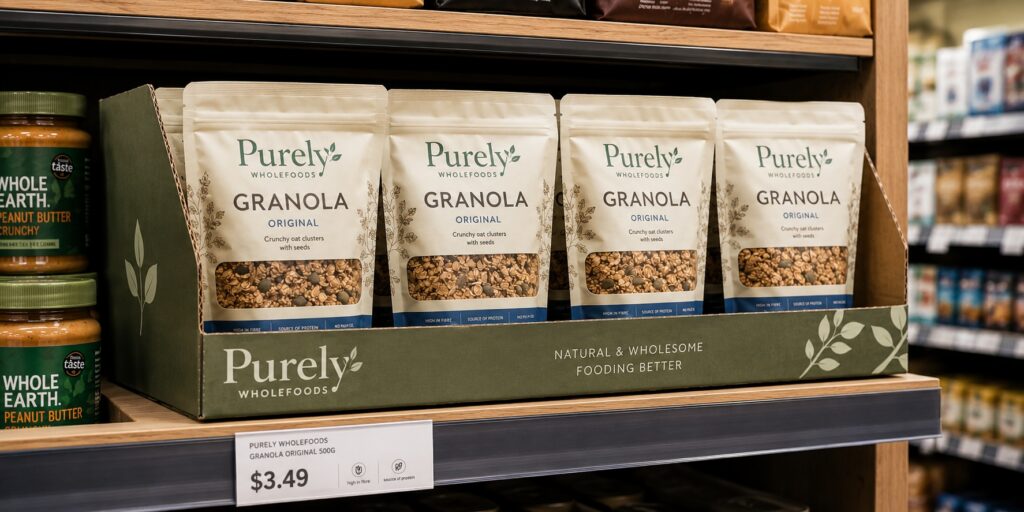
Shelf-ready or display-ready secondary packaging. Most mid-to-large retailers now expect cases that can be placed directly on shelf without repacking. This means a perforated tear strip that opens cleanly in one motion, a tray that holds units in the correct shelf orientation, and a front panel with brand blocking that remains legible as inventory sells down. The specific requirements vary — some retailers want a full shelf-ready tray, others accept a top-open case with a clean front face. Pull the retailer’s vendor guide before briefing your packaging supplier.
How Requirements Vary by Retailer Type
Retail-ready requirements are not uniform. What passes at a regional natural grocery may be insufficient for a national mass retailer, and what works at a club channel requires different dimensions entirely.
Regional and independent grocery. Requirements are often documented in a supplier guide but enforcement is less rigid than national accounts. Shelf-ready trays are preferred but not always mandated on a first order. Case counts are often negotiable. This is the right channel to start in if you’re validating retail packaging before investing in a full national-spec format.
Natural and specialty retailers (Whole Foods, Sprouts, Fresh Market). Published vendor guides with specific case dimensions, facing counts, and shelf-ready requirements. Whole Foods in particular has detailed packaging and sustainability criteria — their supplier requirements are publicly available and worth pulling before you brief your packaging supplier. Shelf-ready is expected in most categories.
National mass (Target, Walmart, Kroger). The most codified requirements. Planogram compliance, case count specifications, label placement mandates, and shelf-ready secondary packaging are standard expectations. These retailers often require packaging samples before a purchase order is confirmed. Budget 6–10 weeks from brief to approved sample if you’re designing a new retail format from scratch.
Club (Costco, Sam’s Club, BJ’s). Club channels use deeper shelf bays and higher per-unit case counts than standard grocery. A case count and tray depth that works for a grocery gondola often doesn’t work for a club bay. If club is a target channel, treat it as a separate packaging brief — the dimensions and case economics are different enough that a grocery retail-ready format rarely adapts cleanly.
Adapt or Rebuild: The Decision Most Brands Face Too Late
When a retailer approaches you, the first question to ask your packaging supplier is not “can we update the artwork?” It’s “does our current secondary packaging meet this retailer’s case count, structural, and shelf-ready requirements?”
If the answer is yes — adaptation is fast. New artwork on an existing dieline, updated case barcodes, sampling turnaround of 2–4 weeks depending on complexity.
If the answer is no — you are looking at a new dieline, new tooling if applicable, structural testing, and a sampling round. That’s a 6–10 week process in most cases, longer if co-packer compatibility needs to be validated. Discovering this after a buyer has asked for samples is the scenario that costs brands the most momentum — not because the retailer walks away, but because the delay creates doubt about operational readiness.
The cost difference matters too. Adapting existing packaging typically runs $500–$1,500 in sampling costs. A new retail-specific format — new dieline, structural testing, two sampling rounds — typically runs $1,500–$4,000 before you’ve confirmed a purchase order. Neither figure is prohibitive at the scale of a retail launch, but discovering you need the latter when you budgeted for the former is a problem. If you’re pitching a custom product box format for retail display, getting the structural spec right at brief stage avoids a second round of samples.
What to Audit Before the Pitch Meeting
Before you sit down with a buyer, work through these four questions against your current packaging.
Does your secondary packaging have a confirmed case count? If you’re currently shipping loose units or in ad-hoc case quantities, establish the case count first. It affects tray dimensions, case barcode setup, and the economics of every subsequent decision.
Have your cases been structurally tested? If not, run an ISTA 2A test before sampling. A case that fails transit testing after a buyer has confirmed interest creates a delay that’s harder to explain than one caught before the pitch.
Do you have case barcodes set up through GS1? If your GS1 company prefix is active, generating ITF-14 case codes is straightforward. If you haven’t registered with GS1 US, that process takes 1–2 weeks and needs to happen before packaging goes to print. The case and shipping box spec needs to include barcode placement from the start — retrofitting it after print is a reprint.
Have you pulled the retailer’s vendor guide? Most retailers publish supplier or vendor compliance guides. They specify case dimensions, label placement, shelf-ready requirements, and sustainability preferences. Read it before briefing your packaging supplier, not after. The guide is the spec. Guessing costs you a sampling round.
- If your primary pack was designed for DTC single-unit shipment → assume secondary packaging needs to be rebuilt, not adapted, and get a structural assessment before the pitch
- If the retailer has a published vendor guide → pull case dimension, count, and barcode specs before briefing your supplier
- If you’re pitching a regional or independent retailer → shelf-ready trays are preferred but not always mandated; confirm before investing in display packaging
- If you’re pitching a national mass or club retailer → shelf-ready secondary packaging is a baseline expectation; budget for it as part of pitch preparation, not as a post-PO expense
The brands that move fastest through retail onboarding are the ones who treated packaging as an operational requirement from the start — not a design decision they’d get to after the buyer said yes. If you’re not sure where your current packaging stands against a specific retailer’s requirements, a spec review before the pitch meeting is a faster path than a sampling round after it.
Understanding retail-ready packaging can be complex.
If you’re unsure about any part, our team can talk you through it before anything goes to print.
Ron Perry
Print Solutions Engineer, Packaging Studio
Ron Perry is Print Solutions Engineer at Packaging Studio, with 23+ years’ experience in commercial print, packaging production, and technical print setup. He focuses on the practical details that make packaging production-ready, including artwork specifications, print processes, labelling requirements, material constraints, and compliance checks. His compliance posts help businesses understand what needs to be considered before packaging artwork goes to print.