
What Makes Corporate Gift Boxes So Effective?

By
••
6 min read
•Industry Insights
The first question brands ask when ordering corporate gift boxes is usually the wrong one. Format — rigid or folding, lid or tuck — is a downstream decision. Volume, lead time, and budget per unit determine what’s actually available to you. Start there.
If you’re at the stage of comparing options and trying to figure out what will actually look premium versus what just costs more, this is where to start.
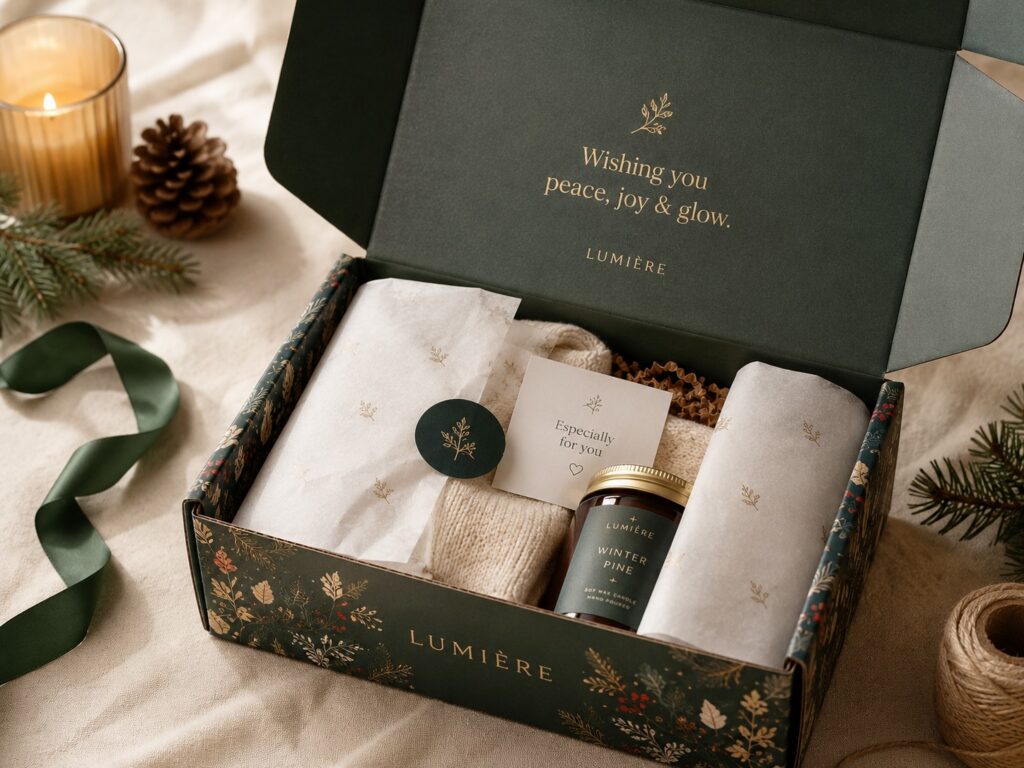
The Decision Most Brands Get Wrong
The default assumption is that a rigid set-up box — the kind with a separate lid — is the mark of a premium corporate gift. It’s not wrong that rigid boxes look elevated. The problem is that most brands ordering under 200 units can’t justify the cost difference, and spend their budget on format when they’d get more perceived value from investing in print quality and finishing on a well-constructed mailer box.
Rigid set-up boxes typically cost 3–5× more per unit than a comparable printed mailer box. They require longer lead times — usually 4–6 weeks versus 1–2 weeks for digital print — and most suppliers require minimum runs of 250 units or more. For a brand sending 75 client gifts before a product launch, that math doesn’t work.
The better question isn’t “rigid or folding?” It’s “what finish, at what volume, within what lead time?”
Format Options and What They Actually Deliver
There are three realistic format options for branded corporate gifting at the volumes most emerging brands are working with.
Printed mailer box. The most accessible entry point for custom branded gift packaging. Digital print allows runs from 50 units upward, with 1–2 week domestic lead times. A well-specified mailer box with the right finish and a clean interior insert delivers a strong unboxing moment. This is the right format for most brands sending under 200 units.
Custom product box. A sturdier construction than a standard mailer box, typically used for single-product gifting where the box itself is part of the presentation. Cost sits between mailer and rigid. MOQs typically start at 100–150 units. Good choice when the gift is a single item with a defined footprint and the box needs to feel more structured.
Rigid set-up box. The highest perceived premium — but only justifiable when the volume and budget support it. At 250+ units with a 4–6 week runway and a budget that can absorb the per-unit cost, a rigid box is the right choice. Below those thresholds, the premium is more theoretical than practical.
Print and Finish: What Actually Creates the Premium Feel
Recipients don’t pick up a gift box and think about its construction. They respond to what they can see and touch: the depth of the color, the texture of the surface, the quality of the print. This is where the decision has the most leverage.
For most corporate gifting applications, the finish options that move the needle are:
- Soft-touch matte laminate. The single most effective finish for communicating premium on a budget. Transforms the tactile feel of the box without significant cost impact. Works well across most brand color palettes.
- Spot UV. A gloss coating applied to specific areas — typically a logo or pattern — over a matte base. Strong visual contrast. Adds $0.50–$2.00 per unit at volume and typically requires 100+ units to be cost-viable. Adds 1–2 weeks to lead time.
- Foil stamping. Higher cost and longer lead time than spot UV, but appropriate for executive-level gifting where the specification needs to match the price point of the contents. Best reserved for rigid box applications at 250+ units.
The most common mistake is ordering a plain CMYK print box without any surface treatment and then wondering why it doesn’t look as premium as expected. The laminate is not optional — it’s the finish that closes the gap between a printed box and a premium one.
Volume and MOQ: What’s Realistic at Each Stage
MOQ assumptions are one of the main reasons brands either overspend or avoid custom gifting packaging altogether. The actual thresholds for digital print are lower than most people expect.
At 50–100 units, domestic digital print is the only viable path. Overseas production is not cost-effective below 500 units — the unit cost savings are eliminated by setup costs and minimum charges, and the 8–12 week lead time makes it impractical for most gifting programs.
At 100–250 units, the format options expand. Specialty finishes become cost-viable. A custom product box becomes accessible. This is the range where most growing brands find their sweet spot — enough volume to unlock better specifications, small enough to stay flexible.
At 500+ units on a planned annual gifting cadence, overseas production becomes worth evaluating. The per-unit cost reduction of 40–60% is meaningful at this volume, but only if the lead time (10–12 weeks minimum) can be built into the program calendar. This is a planned-program decision, not a reactive one.
How to Match Spec to Use Case
The right corporate gift box specification depends on three variables: volume, lead time, and budget per unit (box only, excluding contents). Here’s how those variables resolve:
- If sending under 200 units → printed mailer box with soft-touch matte laminate; rigid box is not cost-justified at this volume
- If brand color accuracy is non-negotiable → specify HP Indigo digital print and request a physical proof before the full run ships
- If the gifting event has a fixed date within 3 weeks → domestic digital print only; no specialty finishes, no overseas production
- If budget per unit is under $8 (box only) → full custom rigid box is not achievable; invest the savings in a stronger insert, tissue, or messaging card instead
- If sending 500+ units on a planned cadence → overseas production becomes cost-viable; build in a 10–12 week lead time and treat it as a program decision, not an order
One thing worth noting: the unboxing moment matters more in gifting than in almost any other packaging context. The recipient isn’t in a retail environment choosing between products — the box arrives, and their entire first impression of the brand is formed in the first five seconds of opening it. A mismatch between the quality of the gift and the quality of the box actively undermines the impression the gift was meant to create.
For brands new to this decision, the unboxing experience guide covers how packaging specification choices translate into perceived value — the same principles apply directly to corporate gifting.
If you’re at the point of comparing format and finish options, the custom mailer box and custom product box pages show what’s achievable at different volumes — with real pricing and turnaround times so you can match the spec to your program before committing.
Making the right choice of gifting box is important.
Our team can talk you through every aspect of gift boxes from sizes, materials and finish, before anything goes to print.
What you should read next
Tom Moriarty
General Manager, Packaging Studio
Tom Moriarty is General Manager at Packaging Studio, with 15+ years’ experience across commercial print and packaging. He has worked closely with brands, suppliers, and production teams, giving him a practical view of how the industry is changing and what those changes mean for businesses. His industry insights focus on trends, challenges, and commercial shifts that affect packaging decisions in the real world.