
Stand-Up Pouch vs Layflat Pouch: When to Use Each

By
••
6 min read
•Getting Started
Most brands choose a stand-up pouch because it looks better on a shelf. That logic makes sense in retail. It breaks down quickly everywhere else.
Layflat pouches cost less per unit, store more efficiently, and work better for products that are never displayed upright. For a brand selling primarily through ecommerce or shipping in bulk to co-packers, defaulting to a stand-up format can add cost without adding value.
The decision comes down to three things: how your product is sold, how it is filled, and what volume you are ordering. Each of those factors points in a different direction depending on where you are.
What Makes These Two Formats Different
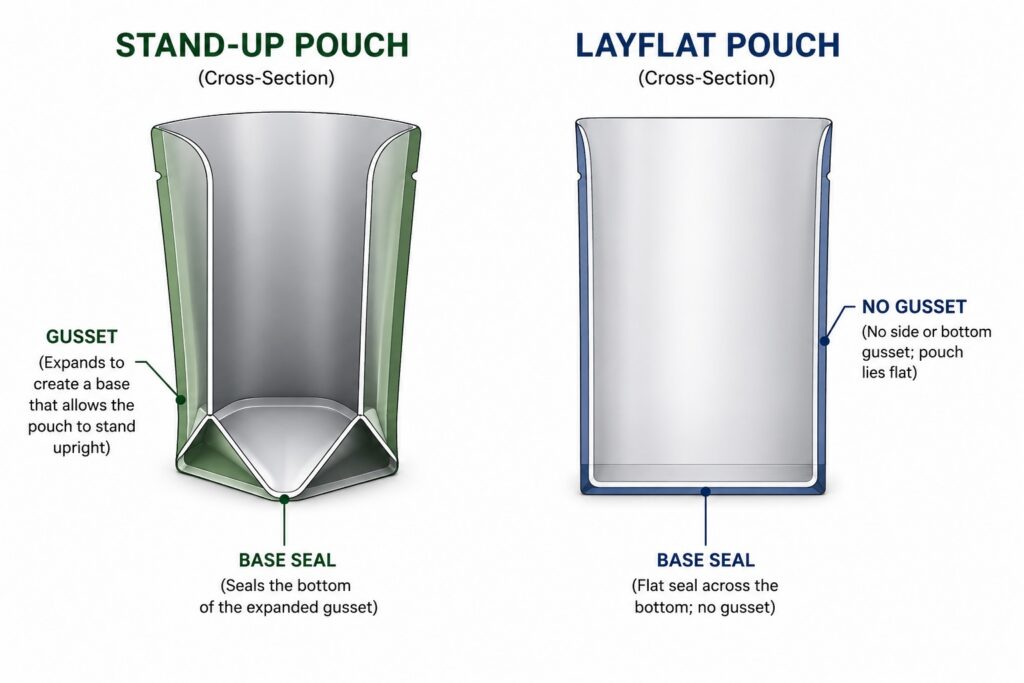
A stand-up pouch has a gusset at the base — a folded section that expands when the pouch is filled, allowing it to stand upright. That gusset adds material, which adds cost. It also adds structure, which is the entire point if you need the pouch to display on a shelf.
A layflat pouch has no base gusset. It lies flat when filled. The profile is thinner, the material cost is lower, and the format is simpler to fill on most automated lines. What it cannot do is stand upright on its own.
Neither format is inherently better. They solve different problems.
Where Stand-Up Pouches Earn Their Cost
Stand-up pouches make sense when the pouch needs to be seen. Retail shelf presence is the clearest case — a pouch that cannot stand is a pouch that cannot be merchandised effectively. If your product is sold in grocery, specialty retail, or any physical retail environment where it sits on a shelf, the gusset is not optional.
They also work well for products where the consumer interacts with the pouch repeatedly. Coffee is a good example. A stand-up pouch with a resealable zipper sits on a counter between uses. A layflat pouch cannot do that reliably.
Stand-up formats are typically available from around $0.45–$0.90 per unit at runs of 500–1,000 units, depending on size, material, and finish. That is a meaningful premium over layflat at similar volumes — and it is worth paying when shelf presence or repeated consumer interaction is part of the product experience.
Where Layflat Pouches Make More Sense
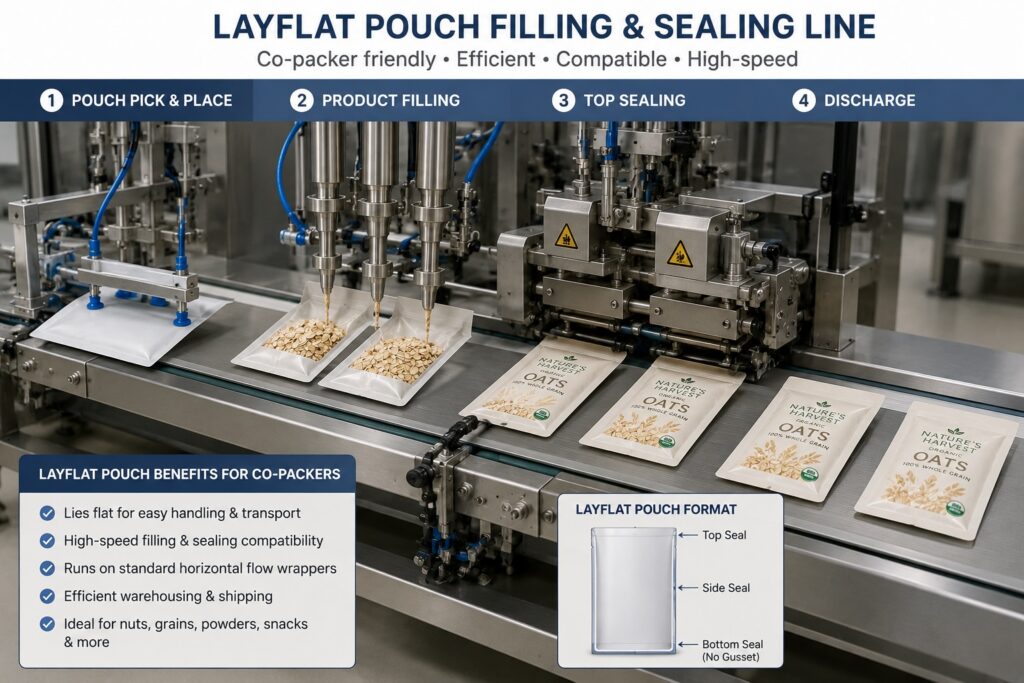
Layflat pouches are better suited to products where display is not the point. Ecommerce brands shipping direct to consumer, brands packaging products for wholesale distribution, and brands filling pouches on automated lines that prefer a flat format all have reasons to choose layflat.
The cost difference is real. At a run of 1,000 units, layflat pouches in a standard size typically come in 15–25% cheaper than a comparable stand-up format. That gap narrows slightly at higher volumes but does not disappear. For brands ordering regularly and watching their cost of goods closely, that difference adds up.
Layflat pouches also pack and ship more efficiently. A flat pouch stacks. A stand-up pouch does not stack the same way, which affects both storage at your facility and shipping density. For ecommerce brands paying to warehouse and ship product, this is an operational consideration, not just a packaging one.
One area where brands underestimate layflat: co-packer compatibility. Many high-speed filling lines are optimized for flat formats. If your co-packer runs a vertical form fill seal (VFFS) machine, they are likely already filling flat pouches. Confirming your co-packer’s preferred format before ordering packaging is always the right sequence — getting that wrong means a format change after the artwork is done.
The Barrier Question Applies to Both
Format is one decision. Material is another. They are often confused.
Both stand-up and layflat pouches are available in a range of barrier films — from standard structures with moderate oxygen and moisture protection to high-barrier films designed for products with longer shelf lives or more sensitive contents. The right barrier level depends on your product, not on which format you choose.
A common mistake is choosing a format first and then discovering the required barrier spec is not available in that format at the volume you are ordering. Barrier specification and format should be confirmed together, not sequentially. If you are working with a co-manufacturer or a food scientist, get their barrier requirement in writing before finalizing the pouch spec.
How to Choose: A Practical Framework
Most founders can resolve this decision by answering three questions honestly.
- If your product sells primarily in retail → choose a stand-up pouch. Shelf presence requires it, and the cost premium is justified by the display function.
- If your product ships direct to consumer or through wholesale → layflat is usually the better starting point. Lower unit cost, better pack efficiency, and simpler filling are all advantages when display is not the goal.
- If your co-packer runs a VFFS machine → confirm their preferred format before ordering anything. Most VFFS lines run flat formats; a stand-up pouch may require a different sealing setup or a format adjustment that costs time and money.
- If you are ordering under 500 units → the cost difference between formats is smaller in absolute terms, but the format choice still affects the customer experience. Focus on the end use, not the unit economics at low volumes.
- If you are selling across both retail and ecommerce → consider whether one format can serve both channels adequately, or whether running two SKUs is justified. Running separate formats for separate channels is manageable but adds complexity to reordering and inventory management.
What Usually Goes Wrong
The most common mistake is ordering a stand-up pouch for a product that is never displayed upright. The brand pays the gusset premium, the pouch arrives, and it goes straight into a shipping box where the structure is irrelevant. This happens most often when founders default to stand-up because it is the format they see most in retail — not because it fits their channel.
The second most common mistake is not confirming the format with a co-packer before ordering. Packaging arrives, the co-packer’s line cannot run it cleanly, and the brand is either paying for a production line adjustment or reordering in a different format. That sequence typically costs 3–5 weeks and a second tooling or setup charge.
Both mistakes are avoidable. The format decision is not complicated — it just needs to be made against the right criteria.
If you are at the point of choosing between formats and want to see how pricing and specs compare for your specific product and volume, custom stand-up pouches and custom layflat pouches are both configurable with real pricing on the platform — no conversation required to see the numbers.

Pasha Hanover
Growth Marketer and Strategist, Packaging Studio
Pasha Hanover is a Growth Marketer and Content Strategist with 10+ years’ experience in performance marketing, brand positioning and customer acquisition. He focuses on how packaging influences buying behaviour, product perception, repeat purchase and brand loyalty. His posts help businesses understand where packaging fits into the wider customer journey and how it can support commercial growth.