
Product Box Sizes: How to Choose the Right Fit for Your Product

By
••
7 min read
•Getting Started
A product box that’s too narrow means the product won’t slide in cleanly. Too wide and it rattles inside, looks underfilled on shelf, and undermines the presentation the box is supposed to create.
Getting the size right is more specific than it looks — product boxes are measured differently from mailer boxes, and the standard size range suits a particular type of product. Below is the full size chart, followed by the 5-step process for matching your product to the right one.
| Size — inches (W×D×H) | Size — cm (W×D×H) | Best for |
|---|---|---|
| 0.63 × 0.63 × 5.5 | 1.6 × 1.6 × 14.0 | Lip balm, mascara, slim pens/stylus, single-use vials |
| 1.5 × 1.5 × 6.22 | 3.8 × 3.8 × 15.8 | Foundation tubes, serums, lipstick/gloss boxes, small supplement bottles |
| 2 × 2 × 4.75 | 5.1 × 5.1 × 12.1 | Candles in tins, compact supplement bottles, small cosmetic jars |
| 2 × 3 × 1.125 | 5.1 × 7.6 × 2.9 | Palettes, blister packs, flat/compact products |
| 2.5 × 2.5 × 1.94 | 6.4 × 6.4 × 4.9 | Cosmetic compacts, square tins, small jars, card decks |
All five sizes are available from 250 units — configure any of them directly on the custom product box page. If none fit, custom dimensions start at the same minimum — see When Custom Sizing Makes Sense below.
Shipping a product rather than presenting it on shelf? Mailer and shipping boxes use a different size range — see Mailer Boxes or Shipping Boxes for those specs.
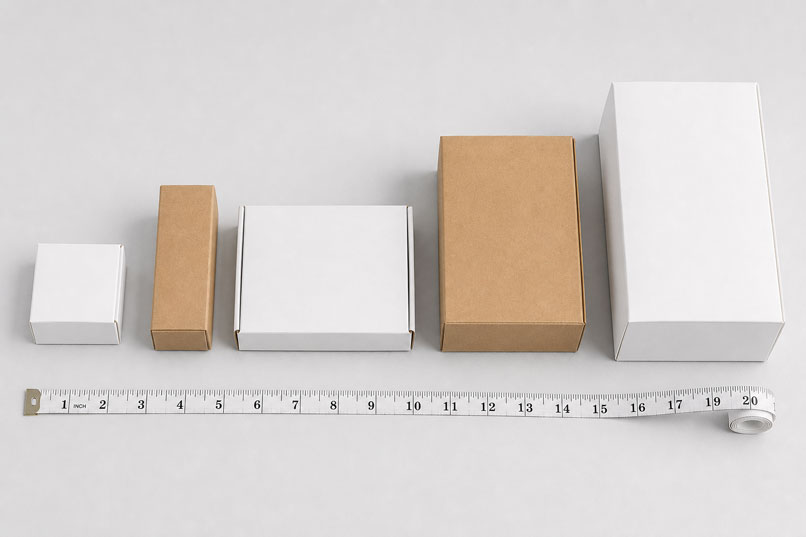
How do I choose the right product box size?
Measure your product at its widest, deepest, and tallest points; add 0.25 inches of clearance to each dimension; account for any insert or liner thickness; then compare against the five standard sizes above. If none fit cleanly, choose custom — same 250-unit minimum, no additional complexity.
Already know your size? Configure your product box now.
Choose the Right Product Box Size: 5-Step Process
- Measure your product at its largest point in each dimension. Width at the widest, depth at the deepest, height at the tallest. For irregular products — a curved bottle, a product with a cap or lid that adds height — measure the bounding box: the smallest rectangle the product would fit inside.
- Add insert or liner thickness. If the product sits in a foam insert, a card tray, or a liner, add the thickness of that material to each relevant dimension before comparing against sizes. Inserts are the most common reason a product that should fit a standard size doesn’t.
- Add 0.25 inches of clearance on each dimension. A box that fits with zero clearance is difficult to pack consistently, and a product that can’t be inserted and removed smoothly creates handling problems at volume.
- Check whether the product is upright or flat. The standard size range is built around upright products — bottles, tubes, jars, slim retail boxes. The one exception is the 2×3×1.125, which suits flat or shallow products. If the product is flat and none of the standard sizes work, custom is likely the answer.
- Match against the five standard sizes above. If it sits cleanly with the right clearance and not too much empty space, that’s the size. If it doesn’t, custom is available at the same 250-unit minimum — no premium for custom dimensions.
How Product Box Dimensions Work
Product box sizes are listed as W x D x H — width, then depth, then height. The card stock is thin enough that the difference between measuring inside or outside the box is negligible — measure your product and match directly against the size listed.
Height is the dominant dimension for most products in this range — bottles, tubes, and slim retail boxes are tall relative to their footprint. Getting the height right is the first filter before comparing width and depth.
When matching a product to a box, the goal isn’t an exact match. A box where the product fits with zero clearance is harder to insert and remove cleanly, and creates inconsistency at packing. The standard allowance is 0.25 inches of clearance on each dimension.
The Standard Product Box Sizes, in detail
0.63 x 0.63 x 5.5
The narrowest standard size. Suited to slim, cylindrical, or very slender products — a lip balm, a mascara, a thin pen or stylus, a single-use vial. At 0.63 inches wide and deep, this is a specialist size for products with a very small cross-section. Anything wider won’t fit.
1.5 x 1.5 x 6.22
A step up in width and depth, taller height. Suited to slim tube-style products — a foundation tube, a serum in a slim bottle, a lipstick or lip gloss in a box, a small supplement bottle. The square cross-section suits products that are roughly the same width and depth.
2 x 2 x 4.75
The most versatile upright size. Suited to a wide range of small retail products — a candle in a small tin, a compact supplement bottle, a small cosmetic jar, a product in a slim carton of its own. At 2 inches square with nearly 5 inches of height, it handles most small personal care and wellness products without requiring custom sizing.
2 x 3 x 1.125
The only flat option in the standard range. Suited to shallow products — a small palette, a thin blister pack, a flat card product, a compact. At just over an inch in height, this size works only for products that sit almost completely flat. Anything taller won’t close.
2.5 x 2.5 x 1.94
A small cube format. Suited to compact, roughly square products — a small cosmetic compact, a square tin, a small jar, a deck of cards, a product in its own square packaging. The near-cube proportions make it the right choice when width, depth, and height are all similar.
When Custom Sizing Makes Sense
Custom isn’t a premium tier. It’s the right answer when standard sizes don’t fit the product well. Custom product boxes start at the same 250-unit minimum as standard sizes.
Go custom when:
- The product is wider or deeper than any standard size can accommodate
- The product height falls between standard sizes and the nearest option leaves more than 0.5 to 1 inch of empty space above the product
- A specific insert or tray requires a precise internal dimension to sit correctly
- The product is irregularly shaped and the bounding box doesn’t match any standard size cleanly
- Brand or retail requirements specify a particular proportion or footprint
Custom sizing doesn’t add significant complexity. The dieline is built to the specified dimensions and the rest of the process — material, finish, Spot UV, foil, artwork setup — runs the same way as a standard order.
Measuring Your Product
Before comparing against any size, measure the product at its largest point in each dimension.
For regular shapes — a cylindrical bottle, a square jar, a flat compact — that’s straightforward. Measure width at the widest, depth at the deepest, height at the tallest including any cap, lid, or closure that adds to the overall height.
For irregular shapes — a pump bottle where the pump head adds height, a product with a wider base than body — measure the bounding box. That’s the smallest rectangular space the product would fit inside. The box needs to accommodate that full envelope.
Add 0.25 inches of clearance to each dimension. If the product sits in an insert or liner, add the thickness of that material to each dimension before comparing sizes.
The resulting three numbers are what to match against the standard sizes.
Getting the Clearance Right
A product box that fits the product exactly — no clearance — is difficult to pack cleanly and consistently. The product has to be pushed in, can catch on the edges, and is harder to remove without damaging the box. At low volumes this is manageable. At any kind of scale it becomes a real handling problem.
Too much clearance creates a different issue. A product that moves inside its box looks underfilled on shelf and feels insubstantial in the hand. For retail products where the perceived quality of the packaging reflects on the product inside, excessive empty space works against the brand.
The target is a fit where the product slides in cleanly, sits securely, and can be removed without force — snug without being tight.
Frequently Asked Questions
Ben Taylor
Product Manager, Packaging Studio
Ben Taylor is Product Manager at Packaging Studio, with 18 years’ experience across commercial print, packaging, and product setup. He understands the practical details behind successful packaging, from substrates and print processes to artwork preparation, design choices, and production requirements. His guides help businesses avoid common setup issues and make more informed packaging decisions before files go to print.