
EPR Compliance by State: 2026 Tracker

By
••
10 min read
•Compliance & Regulation
Seven states now have active packaging EPR laws. Several compliance deadlines have already passed.
If your brand sells packaged goods in Oregon, Colorado, or Washington and you haven’t registered with a Producer Responsibility Organization, you’re not behind on a future requirement — you’re behind on a current one. Oregon’s first fees were due in July 2025. Colorado’s began in January 2026. Washington required PRO appointment by January 1, 2026.
EPR is no longer a policy to watch. It’s a compliance calendar to manage.
What EPR Requires Producers to Do
Extended Producer Responsibility (EPR) shifts the cost of managing packaging waste from municipal governments to the companies that put packaging into the market. In practice, that means brand owners — not retailers, not co-packers, not packaging suppliers — are responsible for registering, reporting, and paying fees.
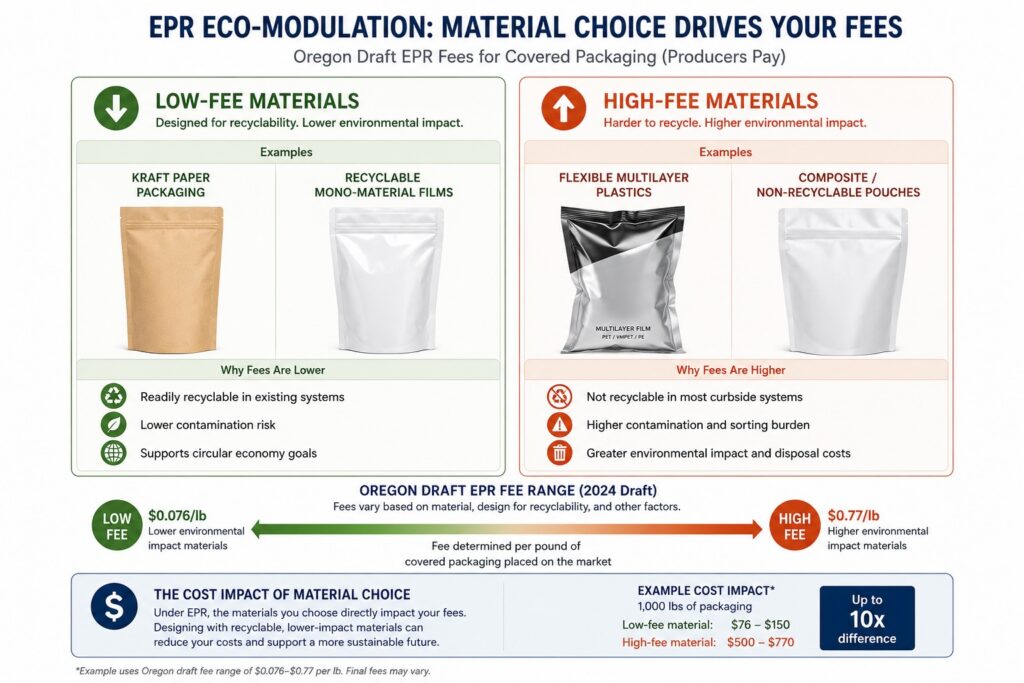
The structure is consistent across all seven active states, even if the timelines differ. Producers above a revenue or volume threshold must: join a state-approved Producer Responsibility Organization (PRO), submit annual packaging data reports detailing material type and weight, and pay fees calculated against that data. The fees are eco-modulated — meaning packaging that is more difficult or costly to recycle incurs higher charges than packaging made from materials with established recycling infrastructure.
That last point matters for packaging decisions. Flexible plastic pouches and multilayer films sit in the highest fee tiers under Oregon’s structure, where draft base fees range from $0.076 to $0.77 per pound of covered material depending on recyclability. Fiber-based formats — kraft paper, recyclable cartons — fall in the lower bands. The fee structure is not neutral across materials.
The Seven Active States: What Each Requires in 2026
Each state passed its law independently, which means exemption thresholds, PRO structures, and deadlines vary. The table below covers what producers need to know for 2026 specifically.
| State | Law | Revenue/Volume Threshold | Key 2026 Deadlines | PRO |
|---|---|---|---|---|
| Oregon | SB 582 (2021) | $5M+ total revenue or significant packaging volume | 2025 data report due May 31, 2026; fees due July 2026 | Circular Action Alliance (CAA) |
| Colorado | HB 22-1355 (2022) | $5.5M+ revenue or 1+ metric ton of packaging annually | Detailed material supply report due May 31, 2026; fees began Jan 2026 | CAA |
| California | SB 54 (2022) | $1M+ in packaged product sales | Baseline data report due 30 days after final SB 54 regulation approval (OAL review through May 2026); full compliance target 2032 | CAA |
| Maine | LD 1541 (2021) | Municipal cost reimbursement model — broad producer coverage | PRO selection Q1 2026; producer registration Q3 2026; first reports due May 2027 | CAA (expected selection) |
| Minnesota | HF 3911 (2024) | Producers registered in 2025 | PRO registration due July 1, 2026; cost coverage begins 2029 at 50%, scaling to 90% by 2031 | CAA |
| Maryland | SB 901 (2025) | Implementation timelines being finalised | Rulemaking active in 2026; permits multiple PROs — monitor state DEQ for deadlines | Multiple PROs permitted |
| Washington | SB 5284 (2025) | More limited small-business exemptions than OR or CO | PRO appointment required by Jan 1, 2026 (passed); simplified supply report due May 31, 2026; formal PRO registration with Dept. of Ecology due March 1, 2026 | CAA (advisory role) |
The Circular Action Alliance (CAA) is the registered PRO in Oregon, Colorado, California, Maryland, and Minnesota. Washington is aligned with the CAA on an advisory basis. For most brands selling across multiple states, the CAA is the single point of registration — but each state’s reporting requirements and fee structures are distinct and must be managed separately.
Does Your Brand Have Obligations?
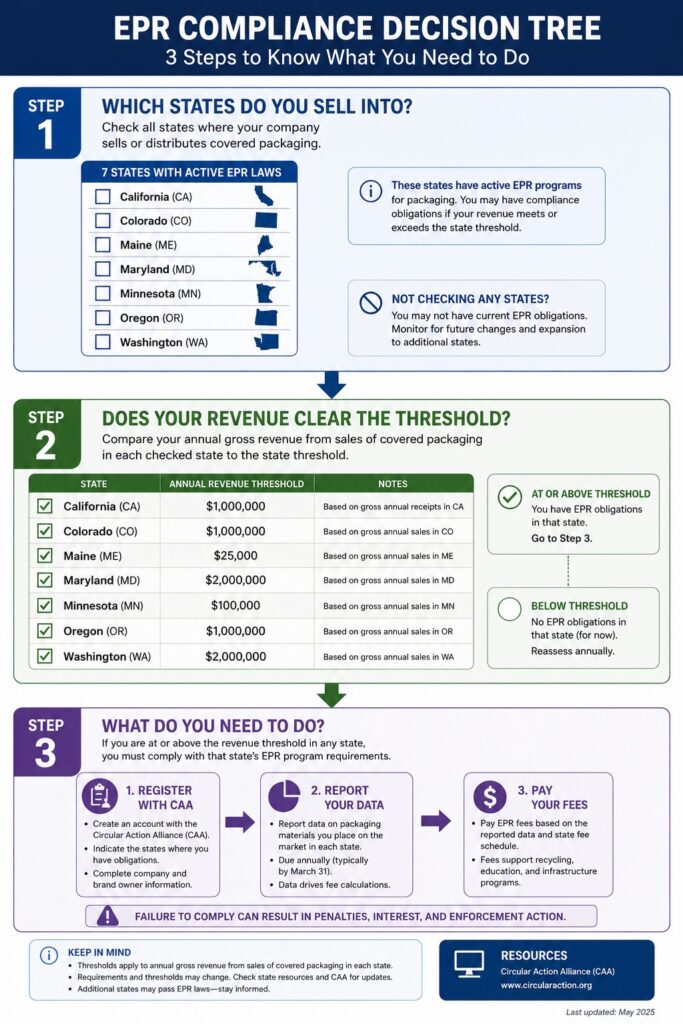
The answer depends on two variables: which states you sell into, and whether your revenue or packaging volume clears that state’s exemption threshold. Neither question has a single answer for all brands.
Revenue thresholds differ materially by state. California captures brands at $1M+ in packaged product sales — a threshold that pulls in a significant portion of consumer brands that might otherwise assume EPR doesn’t apply to them. Colorado and Oregon both set their threshold at or above $5M total revenue, which exempts many smaller brands in those states even while they remain in scope in California. Washington’s exemptions are narrower still — brands that might qualify for small-business status in Oregon may not qualify in Washington.
Brands selling into all seven states need to run the threshold check for each state independently. A $3M coffee brand distributing nationally could be in scope in California while exempt in Oregon and Colorado. That same brand selling in Washington needs to verify its status against Washington’s specific exemption criteria, which are still being clarified through rulemaking.
The obligation sits with the brand owner or first US importer who places covered packaging into the state. Retailers are not responsible. Co-packers are not responsible. Packaging suppliers — including Packaging Studio — are not legally defined as producers under any of the seven active laws. If your packaging ends up in the hands of consumers in a covered state, the obligation follows the brand.
What “In Scope” Requires You to Do
Once a brand determines it has obligations in one or more states, there are three operational steps: register with the relevant PRO, gather and submit packaging data, and pay fees on schedule.
Registration is the first step and the one with the hardest deadlines. For Oregon, Colorado, and California, registration is through the CAA at circularactionalliance.org. Washington required PRO appointment by January 1, 2026 — that deadline has passed. If your brand sells into Washington and hasn’t yet registered, you’re already non-compliant and should act immediately.
Packaging data reporting requires knowing your packaging materials at the SKU level — material type (plastic, fiber, glass, metal), weight per unit, and estimated volume sold into each covered state. For brands that don’t currently track packaging data by material and weight, this is the most time-intensive part of compliance. Oregon and Colorado both have supply reports due May 31, 2026. California’s baseline report triggers 30 days after SB 54 regulation finalization, which was under OAL review through May 2026.
Fee payment follows reporting. Oregon’s fees were first due July 2025; the next round is due July 2026. Colorado’s fees began in January 2026 based on the 2024 supply data. The fees are calculated using eco-modulation multipliers — packaging made from materials with low recyclability rates in the state’s collection system is charged at a higher rate per pound than packaging made from widely collected materials. Brands using flexible multilayer films should budget for the higher end of the fee range when modeling compliance costs; a 15–40% uplift on packaging spend is a realistic estimate for those materials.
Should You Register Now or Wait for Final Regulations?
For Oregon and Colorado, this question is settled — their programs are fully operational and deadlines have passed. If you’re in scope, you register and report now.
For California, the question is live. SB 54 regulations were under OAL review through May 2026, with baseline reporting due 30 days after final approval. Registering with the CAA before the regulations are finalized locks you into the process but limits the risk of missing a tight post-approval window. Waiting until regulations are final is technically permissible but compresses your preparation time to 30 days. For brands with complex SKU portfolios or limited internal data infrastructure, 30 days is not enough to pull together accurate supply data from scratch.
For Washington, the window has closed. The PRO appointment deadline was January 1, 2026, and the simplified supply report is due May 31, 2026. Washington’s limited small-business exemptions mean the default assumption should be that you have obligations — not that you’re likely exempt.
For Minnesota and Maryland, 2026 is largely a setup year. Minnesota requires PRO registration by July 1, 2026, but fee obligations don’t begin until 2029. Maryland’s rulemaking is still active and implementation timelines are being set. Both states are worth registering in now to avoid deadline risk, but neither has near-term fee exposure.
Managing Compliance Yourself vs. Using a Compliance Service
The CAA handles registration centrally for most active states, which reduces some administrative burden. But assembling accurate packaging data — material type, weight per SKU, sales volume by state — is a brand-side responsibility that the CAA cannot do for you.
For brands with 10 or fewer SKUs and clean packaging specs on file, internal compliance management is realistic. The data requirements are specific but not technically complex once the spec data exists.
For brands with 20+ SKUs, multiple packaging formats, or no existing system for tracking packaging by material and weight, the data-gathering burden is significant. Third-party compliance consultants and services can compress initial setup time considerably. Setup costs typically range from $2,000 to $10,000+ depending on SKU count, states covered, and how much of the data infrastructure needs to be built from scratch. That cost needs to be weighed against the internal time cost of running the same process manually — and against the penalty risk of reporting errors or missed deadlines.
States to Watch in 2026
Four additional states have packaging EPR legislation in active consideration as of early 2026.
New Jersey reintroduced its packaging stewardship bill in January 2026, requiring producers to adopt and implement stewardship plans. Previous versions failed to advance in prior sessions but the bill is active again and has committee support.
Massachusetts has a packaging EPR bill that was reported favorably to the full state Senate in 2025 and could move to a vote in 2026. The Massachusetts bill targets recycling infrastructure funding and would follow a producer fee model similar to Oregon’s.
New Hampshire and Wisconsin have both introduced EPR legislation in 2026, with proposals still in early legislative stages.
None of these states has passed a law as of this writing, and pending bills frequently stall or get amended significantly before passage. But for brands already managing compliance in the seven active states, the pattern is consistent: bills that fail one session tend to return with stronger support the next. Brands selling into New Jersey should in particular track this closely given the state’s size and its proximity to existing northeastern markets.
What This Means for Packaging Material Choices
EPR doesn’t directly require brands to change their packaging formats. But the eco-modulation fee structure creates a real cost difference between material categories — one that compounds across multiple states and grows as more states come online.
Flexible multilayer plastic packaging — the dominant format in coffee, pet food, cannabis, and many DTC categories — currently sits in the highest eco-modulation fee tier in Oregon’s structure because it is not widely collected in residential recycling systems. Brands using these formats will pay more per pound than brands using mono-material films, kraft paper-based formats, or packaging meeting Oregon’s recyclability criteria for its Uniform Statewide Collection List.
For brands that are planning a packaging refresh or evaluating new formats, the EPR fee differential is now a legitimate factor in the cost model — not just a sustainability consideration. The fee gap between a widely recyclable format and a non-recyclable multilayer film may be small at low volumes, but at 10,000+ pounds of packaging per year sold into multiple covered states, it becomes a number worth running. If you’re evaluating stand-up pouches or other flexible formats, understanding where your current material sits in the eco-modulation structure should inform that conversation.
Material choices made today will be reported against in future compliance cycles. Getting visibility into the fee exposure now — before the packaging is ordered — is significantly more useful than finding it in a fee invoice twelve months later. For a practical starting point on what film materials are available and how they compare on recyclability criteria, the guide to choosing the right pouch film for your product covers the material options in detail.

Pasha Hanover
Growth Marketer and Strategist, Packaging Studio
Pasha Hanover is a Growth Marketer and Content Strategist with 10+ years’ experience in performance marketing, brand positioning and customer acquisition. He focuses on how packaging influences buying behaviour, product perception, repeat purchase and brand loyalty. His posts help businesses understand where packaging fits into the wider customer journey and how it can support commercial growth.