
Custom Packaging vs Stock Packaging: Which is Better for Growing Brands?

By
••
10 min read
Packaging is often a shopper’s first interaction with your brand. For growing brands, the choice between stock packaging and custom packaging affects unit economics, lead times, perceived value, and sustainability. This guide outlines how each option works, what it costs, how quickly you can get it, and when to choose one over the other, so you can align packaging decisions with your growth stage and operational goals. Many leaders ask, custom packaging vs stock packaging: which is better for growing brands? The answer depends on your timeline, volume, and the experiences you want to create.
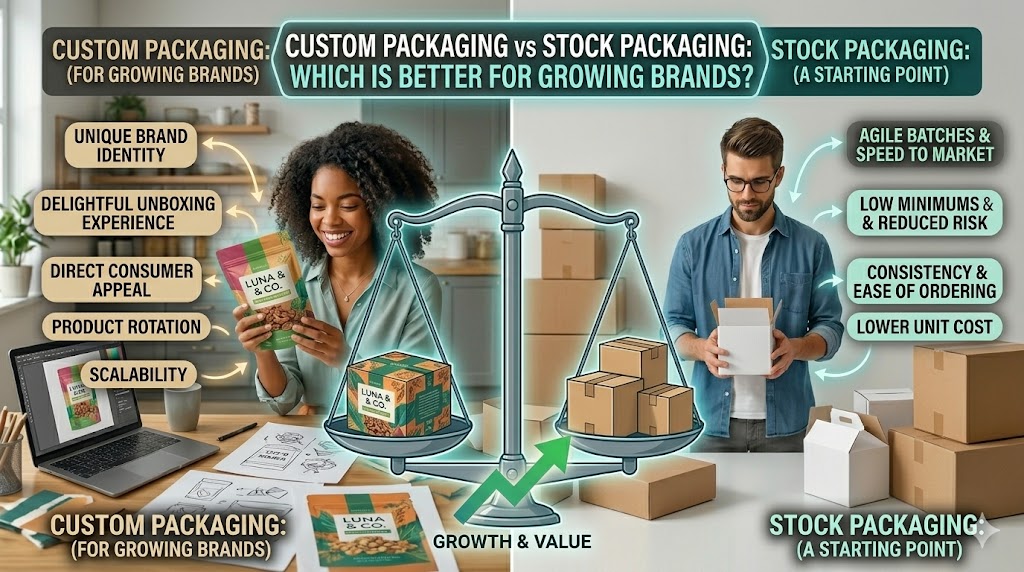
Understanding Stock Packaging
Stock packaging consists of ready-made, off-the-shelf formats available from distributors and online suppliers. Popular stock packaging solutions include standard mailer boxes, poly mailers, folding cartons in common sizes, glass and plastic bottles, jars, stand-up pouches, and corrugated shippers. You can apply light branding with labels, stickers, sleeves, or tape without changing the structural design.
Standardization is the defining feature. You select from established sizes, materials, and styles that manufacturers produce in high volumes. These items typically come with limited color choices, conventional flaps and closures, and compatibility with common accessories like basic inserts and void fill.
Cost and speed are the main advantages. Large-scale production keeps per-unit prices low and minimum order quantities (MOQs) modest. Many SKUs ship within 24–72 hours, supporting continuity when demand shifts or forecasts change. For early-stage brands, pilots, and smaller runs, stock packaging solutions offer reliable quality, quick replenishment, and accessible pricing.
Exploring Custom Packaging
Custom packaging is designed around your product and brand. It covers tailored dimensions, engineered structures, custom printing inside and out, specialty finishes, unique closures, inserts, windows, and substrate selection. The primary benefit is control, over the unboxing experience, product protection, and brand expression. These are core advantages of custom packaging when building loyalty and differentiation.
Design flexibility enables stronger storytelling. You can match precise Pantone colors, add tactile finishes like soft-touch or linen textures, use spot UV for contrast, and incorporate messaging panels or QR codes to guide next steps or encourage repeat purchases. Structural customization reduces damages by creating snug fits, protective inserts, and right-sized cartons that lower dimensional weight.
Material choices range from premium paperboards and kraft corrugate to rigid set-up boxes, molded pulp, and flexible films with barrier properties. Sustainability options include certified papers (FSC), high post-consumer recycled content, water-based inks, and coatings that preserve curbside recyclability. Many brands transition to custom to remove excess void fill, cut freight costs, and strengthen recyclability claims to meet retailer and marketplace standards. For founders evaluating custom packaging vs stock packaging: which is better for growing brands?, these sustainability levers are often decisive advantages of custom packaging.
Key Differences Between Custom and Stock Packaging
Customization depth sets these approaches apart. Stock provides fast access to common sizes with simple branding via labels or sleeves. Custom unlocks full-coverage print, engineered structures, tailored inserts, and specialty finishes that elevate perceived value and improve brand recall. This is where the advantages of custom packaging often become measurable, especially in premium categories.
Lead times and workflows differ. Stock items are pre-made and ship quickly. Custom requires dieline development, prototyping, material sourcing, printing, and converting. Typical lead times for common custom formats run 10–25 business days after artwork approval, extending to 6–10 weeks for complex builds or peak seasons. Digital printing can shorten timelines for smaller runs, while offset and flexo deliver stronger unit economics at scale.
Costs vary by quantity and complexity. At low volumes, stock minimizes upfront spend and avoids tooling. Custom often brings higher MOQs and potential tooling or plate charges, though many providers waive tooling for standard structures. As volumes increase, custom can become more economical thanks to optimized dimensions, reduced components, and lower shipping waste. The breakeven point often appears once you reorder the same configuration at mid-to-high volumes.
When to Choose Stock Packaging
Stock packaging excels when speed, simplicity, and cash conservation are priorities. It fits product launches with uncertain demand, seasonal or limited-time offers, wholesale samples, and early ecommerce tests. If SKUs change frequently or you are validating market fit, stock reduces risk and stock packaging solutions can bridge early growth stages without locking in capital.
For low-volume production, stock keeps MOQs manageable and limits storage needs. You can purchase smaller lots, add branded labels, and update copy or regulatory details without scrapping printed inventory. This is particularly effective for subscription box pilots, pre-orders, and crowdfunding campaigns with tight timelines and evolving forecasts.
Operationally, quick replenishment helps avoid stockouts. Standard sizes are designed to work with common shelving, pick-and-pack setups, and carrier rate brackets. Many fulfillment centers are optimized for typical carton sizes, which can reduce packing time and errors while processes are still maturing.
- Fast availability for launches and tests
- Lower upfront costs and flexible MOQs
- Simplified operations with standard dimensions
- Easy to brand with labels, sleeves, and tape
When to Choose Custom Packaging
Custom packaging is the better choice when you need to stand out, protect delicate goods precisely, or satisfy retailer specs that dictate placement for barcodes, warnings, or branding. If the unboxing moment drives perceived value, as in beauty, electronics, premium food and beverage, and direct-to-consumer gifts, custom can boost conversion and retention. For founders comparing custom packaging vs stock packaging: which is better for growing brands?, these moments are where the advantages of custom packaging shine.
Custom supports long-term brand building. Consistent color, typography, and materials strengthen identity across retail, ecommerce, and social channels. Engineered inserts present products cleanly and reduce returns by preventing transit damage. Over time, right-sizing cuts shipping costs, improves sustainability metrics, and simplifies replenishment through repeatable SKUs.
Examples include coffee roasters using custom-printed bags with degassing valves and branded cartons for multipacks; skincare brands shipping in custom rigid mailers with soft-touch finishes; and electronics startups deploying molded pulp inserts with full-bleed print that educates customers on setup. These touches enhance first impressions and drive word of mouth. This is also where custom packaging for small businesses can scale gradually, starting with one hero component before transitioning full kits.
- Stronger shelf impact and unboxing experiences
- Reduced damage through precise fit and inserts
- Optimized freight via right-sized packaging
- Defined sustainability choices and claims
Side-by-Side Comparison
| Factor | Stock Packaging | Custom Packaging |
| Speed | Ships in 24–72 hours for most items | 2–4 weeks for common formats; longer for complex builds |
| MOQ | Low; buy by the case or small lots | Higher; varies by format and print method |
| Branding | Labels, sleeves, limited print options | Full-coverage print, specialty finishes, custom structures |
| Unit Cost | Lower at small quantities | Improves with volume; can beat stock when right-sized |
| Operational Fit | Works with standard fulfillment setups | Optimized for product protection and dimensional weight |
| Sustainability | Common recycled, recyclable options | Specify materials, inks, and design to remove waste |
How to Decide: A Practical Framework
Use a staged approach to align packaging with growth and risk tolerance:
- Validate: Start with stock for pilots or early sales. Add branded labels or sleeves for a cohesive look without committing to large print runs.
- Stabilize: As demand becomes more predictable, introduce a custom “hero” component such as a branded mailer or folding carton to standardize the experience.
- Scale: Transition core SKUs to custom structures and inserts. Right-size dimensions to reduce damages and shipping costs, and lock in price breaks at higher volumes.
Quantify total landed cost rather than unit price alone. Consider damages, returns, dimensional weight, pick-and-pack time, storage, and material waste. Often, the savings from right-sizing and fewer damages offset higher unit costs in custom packaging. This is especially practical custom packaging for small businesses that need to prove ROI as they scale.
Cost, Lead Time, and Print Method Considerations
Custom costs depend on materials, print method, finishes, and volume. Digital print is ideal for shorter runs, frequent artwork changes, and faster turns. Offset and flexo typically offer better unit economics at scale and support more complex finishes.
- Digital print: Lower MOQs, quicker setup, good for versioning and testing.
- Offset print: High-quality graphics on folding cartons and rigid boxes at mid-to-large volumes.
- Flexo print: Efficient for corrugated shippers and mailers at scale with solid color coverage.
Lead time planning matters. Build in time for structural design, sampling, and transit. For major launches or retailer resets, work backward from in-store dates to ensure approval cycles and production windows are covered. When evaluating custom packaging vs stock packaging: which is better for growing brands?, factor in the calendar and the buffer you need for artwork changes.
Frequently Asked Questions
How do I choose between stock and custom if I’m scaling quickly?
What are typical MOQs for custom packaging?
Does custom packaging always cost more?
Can stock packaging be branded effectively?
Which is more sustainable: stock or custom?
How long does custom packaging take?
Bottom Line: Which Is Better for Growing Brands?
There is no single right answer. Stock packaging delivers speed, flexibility, and low upfront cost, ideal for testing and early growth. Custom packaging delivers brand impact, protection, and long-term efficiency, ideal for scaling with confidence. A phased approach that starts with stock, introduces a custom hero element, and then transitions core SKUs to custom as volumes stabilize will help you control risk while unlocking brand and cost advantages. When you compare custom packaging vs stock packaging: which is better for growing brands?, align the decision with your goals and timelines, and use the advantages of custom packaging where they matter most, storytelling, protection, and right-sizing, while leaning on stock packaging solutions for speed and cash flow. This balance is especially effective custom packaging for small businesses graduating from pilots to predictable scale.