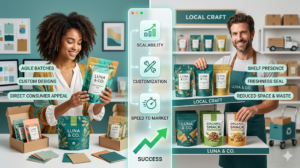
The 40-Day Advantage: How Short-Run Packaging Gives You More Time to Sell

Short-run packaging compresses production timelines, reduces risk, and unlocks a powerful window to sell sooner often delivering up to 40 extra days of selling time compared with traditional long-run approaches. By producing smaller, targeted batches on faster schedules, you can launch quickly, refine messaging in-market, and keep inventory lean, freeing up more days to actively sell and replenish. Packaging Studio specializes in agile, short-run solutions that align production cadence with your go-to-market plan, so you can meet demand, validate ideas, and optimise each cycle without being locked into lengthy commitments or excess stock. The 40-day advantage: how short-run packaging gives you more time to sell is central to our approach, combining short-run packaging benefits with flexible packaging solutions that fit your operational rhythm.
Table of Contents
1) What Is Short-Run Packaging?
Short-run packaging is the practice of producing limited quantities of cartons, labels, wraps, or mailers tailored to immediate sales objectives, promotions, pilots, and regional tests. Instead of ordering tens of thousands of units, you commission smaller batches typically in the hundreds or low thousands on an accelerated timeline using agile printing and finishing workflows designed for speed, accuracy, and brand consistency.
Short runs trade scale for responsiveness. Traditional long-run jobs are well suited to mature products with stable demand but require larger upfront investments, extended lead times, and complex inventory management. Short-run orders, by contrast, enable quick setup, lower capital exposure, and the freedom to iterate. This agility translates into faster learning cycles, tighter product–market fit, and more days in the calendar to sell. These short-run packaging benefits are amplified when paired with flexible packaging solutions that adapt to changes in demand and design.
Common applications include seasonal editions, limited-release flavours, regional trials, refreshed regulatory copy, influencer or co-branded collaborations, and event-driven promotions. Short-run methods shine in categories where consumer preferences evolve rapidly: food and beverage, beauty and personal care, nutraceuticals, direct-to-consumer brands, and specialty retail. At Packaging Studio, we support these requirements with digital and offset print, structural design, and embellishments engineered for small-batch efficiency showcasing short-run packaging benefits within flexible packaging solutions.
In practical terms, short-run packaging is small-batch, fast-turn production tailored to near-term goals ideal for tests, promotions, agile inventory strategies, and rapid iteration without committing to the scale and risk of long-run quantities. It embodies the 40-day advantage: how short-run packaging gives you more time to sell by removing friction and enabling faster market entry.
2) Speed to Market: Capture Up to 40 Extra Days of Selling Window
Speed to market is the core advantage of short-run packaging. By minimising prepress cycles, tooling requirements, and procurement hurdles, you can move from concept to shelf in weeks or even days, not months. That acceleration often creates 40 extra days of selling window time you would otherwise lose waiting for long-run tooling, approvals, or freight. Those recovered days compound into tangible revenue gains, faster product validation, and more responsive replenishment.
Short-run workflows accelerate launches in three ways: reduced setup time through digital and semi-digital processes; color-accurate proofs that streamline approvals; and flexible scheduling that prioritises urgent runs and small-batch replenishment. The result is a tighter, more predictable timeline, the difference between catching a seasonal trend at peak and missing it. These short-run packaging benefits are the heart of the 40-day advantage: how short-run packaging gives you more time to sell.
Consider a few examples: a craft beverage brand releases a limited summer flavour using a short-run can wrap in under three weeks; a skincare company updates compliance copy following a regulatory change without discarding existing stock; a snack start-up tests three packaging variants in parallel to see which converts best online. In each case, short-run methods created room to move faster and sell sooner.
Agility matters in today’s landscape. Consumers expect frequent refreshes, retailers want novelty and consistency, and eCommerce favours iterative optimisation. Short-run packaging aligns with these realities helping you pivot, refine, and replenish without disruption. The 40-day advantage becomes your window to validate the offer, build momentum, and keep products fresh on shelf while competitors wait for long-run cycles to catch up. Flexible packaging solutions further streamline this agility by enabling quick format changes and material swaps.
To increase production in the short run, tackle controllable bottlenecks over the next 40 days: simplify artwork to minimise revisions, standardise dielines to reduce tooling, choose substrates with reliable availability, and schedule staggered batches to maintain flow. Partner with a responsive converter like Packaging Studio that can run more frequent, smaller jobs enabling incremental scaling while preserving speed, quality, and consistency through flexible packaging solutions.
3) Flexibility and Customisation
Short-run packaging thrives on tailored design. When you are not locked into massive quantities, you gain freedom to create limited editions, hyper-local variants, and personalized messaging with minimal risk. This flexibility invites creativity collector series, co-branded campaigns, on-demand regional SKUs, or micro-targeted designs that speak directly to a niche audience.
Customisation options include spot varnishes, soft-touch finishes, metallic inks, foils, and variable data printing for personalised elements all viable at small batch sizes. Structural choices range from DTC mailer boxes to shelf-ready cartons optimised for retail impact. Packaging Studio collaborates on dielines, materials, coatings, and embellishments to balance budget, performance, and brand ambition delivering short-run packaging benefits inside flexible packaging solutions.
Seasonality and trend responsiveness are straightforward with short-run methods. Align packaging to holidays, local events, or influencer activations without committing to months of inventory. This nimbleness supports editorial calendars, retail resets, and quick pivots when a creative or claim outperforms expectations. Instead of carrying excess stock, you iterate in smaller steps and turn learning into margin.
Short runs are also ideal for product tests. Launch a pilot with multiple design variations, measure conversion, retention, and sell-through, then refine based on real-world data. The learning loop design, launch, measure, optimise fits neatly within a 40-day cycle, creating space to improve faster than competitors operating on longer timelines. This is the 40-day advantage: how short-run packaging gives you more time to sell in action.
To maximise profits in the short run, match supply precisely to near-term demand. Use small batches to prevent overproduction, apply A/B testing to optimize design and claims, negotiate economies on shared components (labels or inserts common across SKUs), and reserve high-cost finishes for top-performing variants. Keep cash flowing by selling through inventory quickly, then reinvest in proven designs and channels turning the 40 extra days of selling window into measurable revenue and reduced risk. These tactics exemplify short-run packaging benefits supported by flexible packaging solutions.
4) Cost Efficiency and Sustainability
Short-run packaging lowers capital risk by reducing upfront commitments. You purchase only what you need for the next sales window, freeing cash for marketing, product development, and replenishment. While per-unit costs may be higher than large-scale runs, total spend is often lower in the near term because you avoid excess stock, obsolescence, and write-offs clear short-run packaging benefits for teams focused on cash flow.
Smaller batches minimise waste across materials and time. You print the quantities you need, reduce scrap, and limit the environmental impact of unused packaging. When a regulation or barcode changes, you are not discarding pallets of outdated cartons, just pivot to the next short batch. Sustainable choices, such as recycled boards, water-based inks, and right-sized formats, pair naturally with limited runs and flexible packaging solutions.
Over time, frequent iteration yields additional cost efficiencies. You reduce storage fees, cut risk of dead stock, and keep products competitive with regular design refreshes. Improved messaging and cleaner execution raise conversion rates and help maintain price integrity. The cumulative effect is an efficient cycle where each run becomes sharper and more profitable than the last especially when those runs are timed to capture a longer selling window.
In practical terms, the short run profit curve reflects profit rising with well-timed batches as design, pricing, and demand alignment improve. Early runs may yield modest margins while you learn; subsequent cycles better targeted, less wasteful push profitability upward until capacity or market saturation creates diminishing returns. Short-run strategies aim to climb that curve faster by tightening feedback loops and by leveraging the 40 extra days of selling window you gain from accelerated production core short-run packaging benefits tied to the 40-day advantage: how short-run packaging gives you more time to sell.
To minimise environmental impact, choose right-sized cartons, optimise palletisation to reduce freight, select recyclable substrates, and consolidate print passes with efficient color management. Packaging Studio advises on materials and workflows that balance performance, cost, and sustainability for small-batch projects, helping you achieve both speed and responsibility with flexible packaging solutions.
5) Planning Short Runs for Operational Strength
Short-run success depends on aligning product, design, and operations around accelerated cycles. Start by mapping your sales windows and promotional calendar, then back into production schedules that create a buffer ideally opening that 40 extra days of selling window before peak demand. Use forecast ranges to define batch sizes, and create trigger points for replenishment based on sell-through rather than fixed timelines.
Standardisation enables speed. Reuse proven dielines, maintain master color profiles, and keep a library of materials with reliable availability. Design for manufacturability simplify panel counts, consider digital embellishments, and plan clear approval criteria. Bundle similar jobs to reduce changeovers, and build staggered runs that keep product flowing while you test and refine. These operational habits reinforce short-run packaging benefits and enable flexible packaging solutions.
Data closes the loop. Track unit velocity by SKU and channel, monitor uplift from creative changes, and quantify margin impact from premium finishes. Use those insights to adjust batch sizes, allocate spend, and decide which variants merit scale. When you treat each short run as both a revenue event and a learning cycle, you compound gains and reduce risk across the portfolio realising the 40-day advantage: how short-run packaging gives you more time to sell.
Frequently Asked Questions
What are the three stages of short-run production?
Economists describe three stages: Stage 1 (increasing marginal returns efficiency improves as inputs are added), Stage 2 (diminishing marginal returns output grows but at a slower rate), and Stage 3 (negative returns adding inputs reduces total output). In packaging operations, this typically looks like initial gains as workflows are streamlined, followed by a plateau where incremental changes yield smaller improvements, and finally a point where overloaded schedules or excessive complexity harm throughput and quality. Understanding these stages helps teams time short-run packaging benefits and plan flexible packaging solutions that avoid bottlenecks.
How do you maximize profits in the short run?
Align batch quantities with near-term demand, run A/B tests to refine messaging and claims, prioritise SKUs with proven velocity, and avoid tying up cash in speculative inventory. Negotiate material choices smartly, consolidate components across SKUs, and reserve premium finishes for designs that demonstrate ROI. Capitalise on the 40 extra days of selling window by launching earlier and replenishing more frequently capturing the 40-day advantage: how short-run packaging gives you more time to sell.
How to increase production in the short run?
Target quick wins: simplify artwork, standardise dielines, choose readily available substrates, and batch similar jobs to reduce changeovers. Employ staggered scheduling and partner with a responsive converter capable of frequent, smaller runs. These steps shorten lead times and help sustain output while preserving quality key short-run packaging benefits enhanced by flexible packaging solutions.
What is short-run packaging?
Limited-quantity packaging produced quickly for immediate sales cycles, tests, or promotions ideal for agile marketing and inventory control. Packaging Studio specialises in small-batch solutions with fast turnaround, consistent color, and reliable finishing, delivering short-run packaging benefits that support the 40-day advantage.
What is the short run profit curve?
It maps profit as output scales in the near term: initial gains as you refine processes and design, rising profitability as supply better matches demand, and eventual diminishing returns as capacity constraints or market saturation appear. Short-run packaging helps you climb this curve efficiently by iterating within tight feedback loops and by using earlier launches to gain more days to sell, embodying the 40-day advantage: how short-run packaging gives you more time to sell.
Why Packaging Studio
Packaging Studio is built for short runs. Our team pairs agile prepress with digital and offset capabilities, structural design expertise, and a materials network optimised for availability and performance. We prioritise color fidelity, repeatable quality, and flexible scheduling so you can seize opportunities without sacrificing consistency. Whether you need a pilot batch, a limited edition, or rapid compliance updates, we help unlock the 40-day advantage turning faster launches into real selling time and measurable results. With short-run packaging benefits embedded in our flexible packaging solutions, we deliver the 40-day advantage: how short-run packaging gives you more time to sell across every cycle.