What ‘Web-to-Pack’ Means and Why It’s the Future of Packaging

By Pasha Hanover

13 min read

What ‘web-to-pack’ means and why it’s the future of packaging is a digitally connected way to design, order, and produce packaging through a unified online workflow from structural design and artwork proofing to printing, finishing, and delivery. It brings the speed and convenience of e-commerce to packaging operations, enabling teams to move from concept to finished boxes, labels, mailers, and flexible formats in days rather than weeks. At Packaging Studio, our online self-serve experience is the next evolution of e-commerce print: on-demand pricing, browser-based editing, 3D previews, 3D packaging design, and production-ready outputs that scale seamlessly from one-off prototypes to national launches.

Understanding what ‘web-to-pack’ means   and why it’s the future of packaging starts with what packaging does. Packaging is the system of materials, structures, and graphics that protect and contain products while communicating value and meeting regulatory requirements. It safeguards integrity across the supply chain, enhances compliance, elevates brand impact at shelf and during unboxing, and influences purchase decisions both in-store and online. Web-to-pack strengthens each of these roles by making packaging faster to produce, easier to customize, and smarter to optimize with data, turning a historically slow, manual process into an agile, measurable channel for custom packaging design.

What Is Web-to-Pack?

Web-to-pack is an end-to-end digital model that links online configuration, artwork creation, proofing, production scheduling, and fulfillment into one continuous workflow. It evolved from the web-to-print movement of the early 2000s, which moved print job management online to lower friction and cycle time. As digital presses, finishing systems, and workflow software matured, those principles extended naturally to packaging uniting structural engineering with high-fidelity graphics and rapid, short-run manufacturing powered by packaging design software.

Core elements of web-to-pack include online configurators for size, substrate, and finish; browser-based editors for artwork and variable data; instant pricing and lead-time estimates; automated preflight to ensure print-ready files; digital printing and cutting; and integrated shipping with live status updates. Within Packaging Studio, these elements converge so teams can experiment with dielines, compare materials, preview 3D mockups and 3D packaging design, and place production orders without leaving the platform. The result is a streamlined path from idea to physical packaging, governed by data and accessible via a self-serve experience.

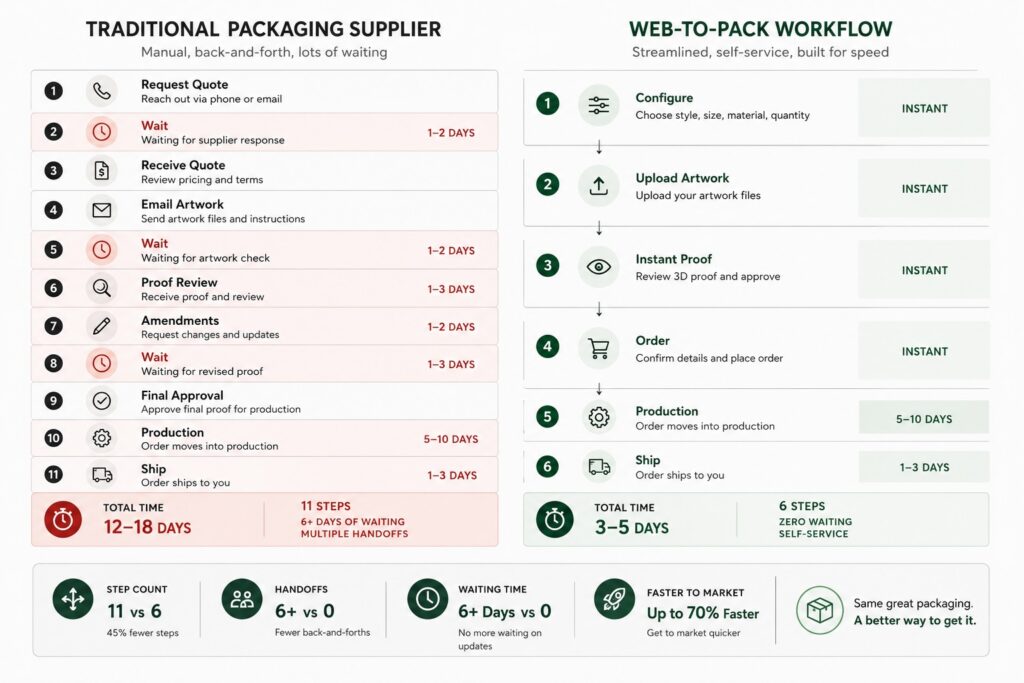
Compared with traditional methods often dependent on manual quotes, email-driven artwork exchanges, and batch production, web-to-pack delivers lower minimums, faster proofs, and tighter, more predictable schedules. It reduces handoffs and compresses the concept-to-carton timeline by removing bottlenecks such as plate creation or external prepress. For brands and operations teams, that means fewer delays, clearer costs, and the flexibility to respond to market signals in real time with custom packaging design guided by packaging design software.

How Web-to-Pack Works

The web-to-pack process follows a structured, digital-first path that reduces manual steps and speeds approvals. A typical sequence looks like this: define goals and packaging types; configure dielines and materials in an online tool; upload or create artwork and validate prepress checks; generate proofs and interactive 3D visualisations for stakeholder sign-off; place the order with instant pricing; move to digital print, cutting, and finishing; and ship with trackable status and notifications. Each stage is connected by shared data, ensuring changes propagate cleanly and version control remains intact for custom packaging design.

Behind the scenes, a stack of interoperable technologies drives the experience. Digital front ends manage colour and RIP processing for presses; automated preflight checks confirm colour spaces, image resolution, bleed, and fonts; variable data tools personalise SKUs, languages, codes, or seasonal messages; and digital cutting tables or laser finishing eliminate tooling for short runs. Cloud storage maintains master assets and version history, while permissioned workflows keep approvals orderly. Packaging Studio ties these pieces together so users can move from concept to delivery with minimal friction and full transparency using packaging design software.

Integration is central to success. Web-to-pack connects with existing systems such as PIM/DAM for product data and assets, e-commerce platforms for SKU and order sync, and ERP/MRP for planning and inventory visibility. It can also link to sustainability modules that estimate material usage, recycled content, and carbon impact. Our team aligns the implementation to your current processes whether modernising legacy lines or launching a digital-first packaging programme so change management is practical, measurable, and low-risk for what ‘web-to-pack’ means   and why it’s the future of packaging.

Benefits of Web-to-Pack for Brands

Web-to-pack delivers measurable gains by compressing lead times, reducing errors, and aligning production volumes to demand. Cost-effectiveness emerges from fewer setup requirements, reduced waste during test runs, and the ability to order exactly what’s needed when it’s needed. Instant quotes and automated prepress save hours of coordination and prevent expensive rework due to file issues. For multi-SKU portfolios, batching short runs on digital equipment can lower total landed cost compared with over-ordering and warehousing, while protecting against obsolescence when artwork or regulations change especially for custom packaging design.

Customisation is where web-to-pack excels. Teams can localise languages, run micro-campaigns, test colourways, and personalise packaging at the recipient level without committing to plates or dies. Seasonal and limited editions become practical and profitable. Packaging Studio enables variable data and image swaps directly in the browser, allowing marketers to deploy creative ideas quickly and measure performance. This turns packaging into a responsive channel for audience-specific messaging, cross-promotion, and loyalty experiences using packaging design software and 3D packaging design.

Turnaround and scalability improve because production can start as soon as proofs are approved often the same day. Digital workflows support quick changeovers and parallel job queues, enabling rapid pilots and just-in-time replenishment. As demand grows, the same processes scale through added print capacity, not added administrative overhead. For subscription and DTC programmes, this translates into on-time deliveries, consistent quality, and agility to adapt mid-campaign based on real-time signals showcasing what ‘web-to-pack’ means   and why it’s the future of packaging.

The Role of Digital Technologies in Web-to-Pack

Digital printing is the engine of web-to-pack. Modern inkjet and toner presses deliver offset-like quality with accurate colour management and tight registration across a wide range of substrates. Because they require minimal setup, small batches become economical, enabling iterative design and continuous optimisation. Paired with digital embellishments spot varnish, foil, and textured effects brands can create premium experiences without extended lead times or tooling costs, supported by packaging design software.

Data-driven decision-making transforms packaging into a test-and-learn channel. A/B testing artwork, QR-linked experiences, and regional variations let teams track engagement and attribute lift to specific design elements. By capturing SKU-level performance and tying it to creative iterations, marketers can refine packaging for conversion, shelf standout, and unboxing delight. Packaging Studio supports version control, analytics-ready variable templates, and traceable identifiers that connect physical packs to digital insights, making measurement part of the core workflow rather than an afterthought with 3D packaging design for immersive previews.

Sustainability gains flow from precise ordering, optimised material selection, and waste reduction. Right-sized structures reduce void fill and shipping emissions. On-demand production lowers obsolescence when artwork or compliance requirements shift. When applicable, selecting recycled or responsibly sourced substrates and water-based inks further reduces environmental impact. Our platform offers substrate guidance and design-for-recycling recommendations, helping teams balance performance with end-of-life goals while maintaining print quality and durability for custom packaging design.

Direct-to-consumer models have accelerated the need for fast, flexible packaging that supports frequent launches and seasonal updates. With short planning cycles and volatile order volumes, teams need packaging that scales week by week without locking into excessive inventory. Web-to-pack is built for this pace, providing transparent pricing, low minimum order quantities, and fast reorders aligned to marketing calendars and demand signals illustrating what ‘web-to-pack’ means   and why it’s the future of packaging.

Consumers increasingly expect personalised, meaningful packaging from limited editions to regional flavours and gift-ready presentations. This preference pairs with the rise of social commerce and unboxing content, where packaging is integral to the product story. For creative teams exploring how digital workflows elevate brand storytelling, The Dieline offers real-world examples of packaging design innovation and consumer impact. Digital workflows make such personalisation feasible at scale.

Digital workflows make such personalisation feasible at scale. With Packaging Studio’s variable data features, teams can roll out name-based or location-specific designs across thousands of units with consistency and confidence, ensuring compliance while protecting brand standards through packaging design software and 3D packaging design.

Emerging industries from health and wellness to craft beverages, beauty, pet care, and electronics accessories benefit significantly from web-to-pack. These sectors often juggle diverse SKUs, rapid innovation cycles, and stringent labelling requirements. Online proofing, batch code personalisation, and rapid prototyping shorten time-to-market while maintaining regulatory accuracy. As retail and marketplace sellers blend physical and digital storefronts, web-to-pack provides a unified path from concept to compliant, conversion-ready packaging that performs across channels for custom packaging design.

Why Packaging Studio’s Self-Serve Platform Is the Next Evolution of E-Commerce Print

Traditional e-commerce print brought speed and accessibility to basic print jobs. Packaging Studio extends that model into complex packaging, combining structural design, artwork versioning, and production automation in one self-serve environment. Our platform delivers the convenience of online ordering with professional-grade controls and integrations, giving teams the ability to:

  • Configure packaging formats, materials, and finishes with instant pricing and lead times.
  • Build and adapt artwork in the browser, including variable data for SKUs, languages, and personalisation.
  • Generate interactive 3D previews, 3D packaging design, and press-ready proofs that simplify stakeholder approvals.
  • Automate preflight to catch and fix common file issues before they create delays or rework.
  • Run short batches economically with digital print and finishing, then scale capacity as demand rises.
  • Sync data with e-commerce, PIM/DAM, and ERP systems to keep operations aligned and transparent.

This is the next evolution of e-commerce print: a self-service packaging platform engineered for speed, control, and integration, capable of transforming packaging from a bottleneck into a growth lever powered by packaging design software and built for custom packaging design.

Implementation Considerations and Best Practices

Moving to web-to-pack doesn’t require a complete overhaul on day one. A phased approach mitigates risk while unlocking value quickly. Consider the following practices to ensure a smooth transition and strong outcomes:

  • Standardise dielines: Identify your most common formats and establish master dielines with defined tolerances, bleed, and fold guidance. Standardisation accelerates proofing and reduces errors.
  • Centralise assets: Use a single source of truth for brand guidelines, templates, images, and compliance copy. Controlled access and versioning prevent outdated or inconsistent artwork from reaching production.
  • Pilot variable data: Start with a limited set of SKUs to test personalisation and regionalisation. Measure performance and refine template logic before scaling across the portfolio.
  • Align sustainability goals: Select substrates and coatings that meet performance needs while advancing recyclability or recycled content. Build right-sizing into standard designs to cut shipping costs and emissions.
  • Train cross-functional teams: Establish shared expectations for colour management, proofing, and approvals. Define who owns final sign-off and how exceptions are handled to keep timelines predictable.
  • Integrate systems: Connect PIM/DAM, e-commerce, and ERP/MRP to eliminate manual data entry and ensure accurate SKU, quantity, and schedule information flows to production.

These steps create the foundation for a resilient, data-driven packaging operation that can adapt quickly and scale cleanly using packaging design software and 3D packaging design.

Future Outlook for Web-to-Pack Solutions

Technology advances will deepen automation and intelligence across the packaging lifecycle. Expect smarter preflight that automatically fixes common errors; AI-assisted artwork adaptation across dielines; predictive scheduling to optimise equipment utilisation; and expanded digital finishing for tactile effects without plates or screens. Improving colour accuracy across substrates will simplify cross-site consistency, while enhanced metadata will make traceability and analytics more robust further demonstrating what ‘web-to-pack’ means   and why it’s the future of packaging.

Challenges to anticipate include colour consistency across facilities, substrate supply variability, and change management for teams accustomed to legacy workflows. As personalisation scales, data governance and version control become critical. Clear artwork ownership, audit trails, and defined approval thresholds help maintain control while moving quickly. Packaging Studio’s permissions, versioning, and role-based workflows support disciplined collaboration without slowing progress, enabling custom packaging design with packaging design software.

To prepare, organisations can take practical steps now: standardise common dielines; centralise assets in a single source of truth; pilot variable data on a limited SKU set; align sustainability targets with substrate choices; and train cross-functional teams on digital proofing and colour expectations. Building these capabilities positions packaging as a core engine of future operations nimble, measurable, and aligned to demand with 3D packaging design.

Frequently Asked Questions

What is packaging and why is it important?

Packaging combines materials, structures, and graphics to protect, contain, transport, and sell a product. It preserves product quality and safety, communicates value and compliance, supports logistics and retail requirements, enhances customer experience, and influences purchase decisions online and in-store. Effective packaging reduces waste, prevents damage, and strengthens brand equity, especially when driven by custom packaging design.

What will replace paper?

No single material will replace paper. Instead, substrates are diversifying by use case. Recycled and responsibly sourced paperboards continue to improve in strength and print quality. For moisture or grease resistance, barrier coatings and recyclable alternatives are advancing. In some applications, fibre-based materials with advanced coatings, bioplastics, or reusable containers may substitute traditional paper or plastic. The future will be a mix of upgraded fibre solutions, smarter coatings, and design-for-recycling practices rather than one material supplanting all others. Packaging Studio can advise on substrates that balance performance, printability, and end-of-life goals using packaging design software.

What are the 5 P’s of packaging?

Many teams reference five P’s to guide packaging strategy: Product (fit-for-purpose structure and protection), Presentation (graphics, finish, and shelf or unboxing appeal), Practicality (ease of use, compliance, and logistics efficiency), Planet (sustainability, materials, and recyclability), and Profit (cost control, supply chain efficiency, and conversion impact). Web-to-pack strengthens each P by enabling rapid testing, right-sized orders, and data-driven improvements that support custom packaging design.

Getting Started with Packaging Studio

Whether you’re updating a single SKU or transforming a global portfolio, you can start small and scale quickly. Explore dieline templates, configure substrates and finishes, upload or build artwork in the browser, and generate 3D previews for fast stakeholder sign-off. Use instant pricing to compare options, place orders on-demand, and track production and delivery in one interface. As you expand, integrate PIM/DAM and ERP systems to keep data aligned and approvals disciplined for custom packaging design.

Our self-serve platform combines the convenience of e-commerce with the rigour of production-grade tooling so you can launch faster, control costs, and continuously improve. Web-to-pack isn’t just a new workflow; it’s a smarter operating model for packaging, built for responsiveness and measurable impact showing what ‘web-to-pack’ means   and why it’s the future of packaging with packaging design software and 3D packaging design.