
Sustainable Packaging Materials: A Cost vs Performance Breakdown for Brands

By
••
7 min read
•Understanding Packaging
Most ops managers assume sustainable packaging costs more. Sometimes it does. But the premium varies by material, volume, and how much your production line can absorb without a revalidation cycle — and those three variables almost never move together.
The standard comparison you find online treats sustainable materials as a single category. They aren’t. Recycled paper, PCR flexible film, and compostable film each carry different cost structures, different performance profiles, and very different implications for your co-packer. Treating them the same is where most material switches go wrong.
This breaks down the three paths most relevant to growing brands, with real cost ranges and the production questions you need to answer before committing to any of them.
Why the Cost Comparison Breaks Down at Small Volumes
Sustainable material premiums are volume-dependent in ways that conventional packaging isn’t. A virgin PE pouch at 1,000 units and a PCR PE pouch at 1,000 units will show a 15–25% cost gap. At 10,000 units from the same supplier, that gap often narrows to 5–10% — and for recycled paper formats, it can disappear entirely.
This matters because most growing brands are making their first sustainable switch at exactly the volume where the premium looks worst. The economics improve as you scale, but you have to decide before you get there.
The other variable that rarely appears in cost comparisons is production compatibility. A material switch that requires your co-packer to revalidate their line — new sealing temperatures, adjusted fill speeds, revised bag geometry — adds 4–8 weeks and real cost before a single unit ships. That’s not a packaging cost. It’s a production cost that most brands don’t account for when they approve the material quote.
The Three Material Paths Worth Comparing
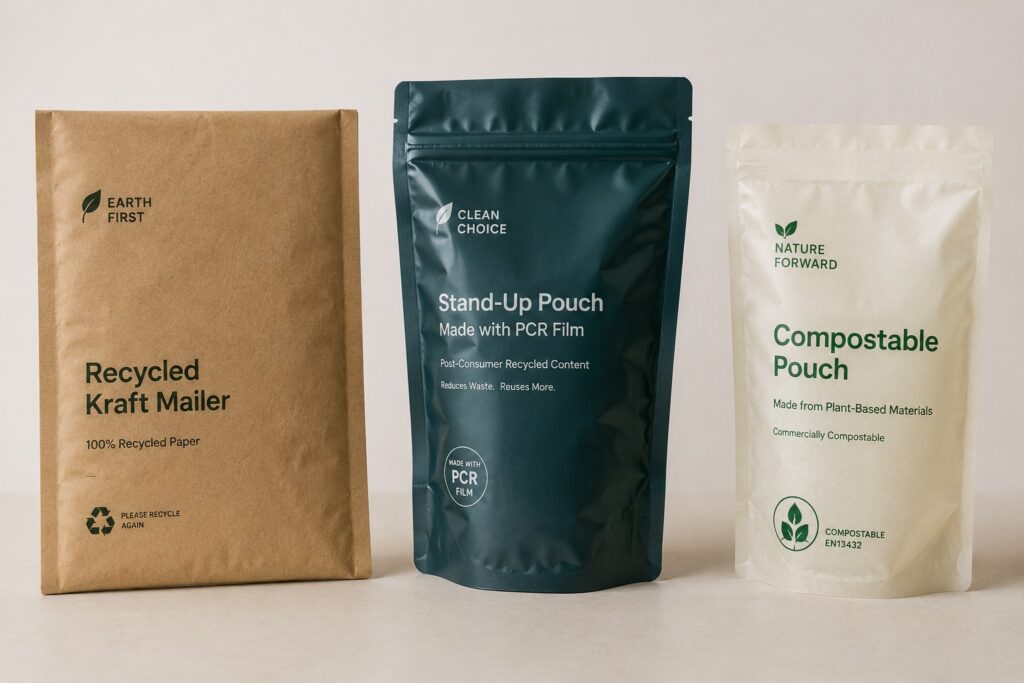
Not every sustainable material is relevant to every brand. The three that matter most for brands in the $500K–$10M range, operating across ecommerce and retail with co-packer relationships, are recycled paper and corrugated, PCR flexible film, and compostable film. Each serves a different application and comes with a different set of trade-offs.
Recycled Paper and Corrugated
Recycled paper is the most operationally straightforward switch available. If your product ships in mailers or boxes and doesn’t require a moisture or oxygen barrier, this is the lowest-risk path. Post-consumer recycled (PCR) paper content has no meaningful compatibility implications for most packaging lines — it runs on the same equipment as virgin paper, and co-packers rarely flag it as a concern.
On cost: expect a 5–20% premium over virgin at low volumes (under 5,000 units). At 5,000–10,000 units, parity is achievable with most suppliers. Above that, recycled content often lands at or below virgin pricing because demand for recycled fiber has matured and supplier capacity has grown.
The hard ceiling is barrier performance. Recycled paper cannot replace high-barrier flexible film for products that need oxygen or moisture protection — coffee, pet food, supplements, anything with a meaningful shelf life. If your format already uses paper, this is an easy switch. If you’re trying to use it to replace a flexible film format, it won’t work.
PCR Flexible Film
PCR flexible film — typically PET, PE, or PP with 30–50% post-consumer recycled content — is the most relevant option for brands that need flexible packaging and want to reduce virgin plastic content without changing format or co-packer workflow.
In most cases, PCR film at 30–50% recycled content is drop-in compatible with existing heat-seal equipment. Sealing parameters may need minor adjustment, but this is usually a trial run, not a formal revalidation. That’s a meaningful operational difference compared to switching to a different format category entirely.
Cost premium runs 10–25% over virgin film at low volumes, narrowing toward 5–10% at higher volumes as PCR supply has expanded. The watch-out is supply volatility: PCR resin pricing tracks virgin resin markets and can spike when virgin prices rise, because converters adjust their PCR allocation. If your brand is cost-sensitive, factor in the possibility of mid-year price adjustments when budgeting a PCR switch.
Compostable Film
Compostable film — typically PLA-based or cellulose-based — is the option brands most often choose for brand perception reasons and least often choose after understanding the operational and infrastructure constraints.
The cost premium is real: 30–60% over conventional flexible film, depending on specification and volume. That premium buys you a material that is industrially compostable — meaning it breaks down correctly in a commercial composting facility at controlled temperature and humidity. It does not break down in a home compost bin, and it does not break down in landfill. In most US markets, industrial composting access for end consumers is limited. For many brands, the compostable claim on the pack cannot be fulfilled by the end-of-life infrastructure available to their customers.
This isn’t an argument against compostable film. It’s an argument for knowing what you’re buying. If your brand sells into markets with strong composting infrastructure — foodservice accounts, certain West Coast retail channels, corporate sustainability programs with managed disposal — compostable film is a defensible choice. If you’re shipping DTC to a national consumer base, the premium is largely a marketing cost, not an environmental one.
On production compatibility: compostable films are more temperature-sensitive than conventional PE or PET. Sealing windows are narrower, and not all co-packer lines can run them without adjustment. This is the one material in this comparison where you should confirm compatibility before ordering samples, not after.
Cost vs Performance: What the Numbers Look Like
| Material | Cost premium vs conventional (low volume) | Cost premium at scale (10K+ units) | Barrier performance | Co-packer compatibility |
|---|---|---|---|---|
| Recycled paper / corrugated | 5–20% | Parity or below | Low — no moisture or oxygen barrier | High — no adjustment required |
| PCR flexible film (30–50%) | 10–25% | 5–10% | High — matches virgin film performance | High — minor sealing adjustment typical |
| Compostable film (PLA) | 30–60% | 20–40% | Medium — adequate for dry goods, not high-barrier | Medium — narrower sealing window; confirm before ordering |
Which Material Is Right for Your Product?
The right choice depends on three things in this order: what your product needs to perform, what your production line can run, and what the cost looks like at your actual volume. Brand positioning comes after those three.
- If your product ships in mailers or corrugated boxes and doesn’t require a barrier film → recycled paper is the lowest-risk switch. Cost parity is achievable above 5,000 units, and there are no production implications to manage.
- If you need flexible film and your co-packer runs standard heat-seal equipment → PCR film at 30–50% content is the most operationally safe path. Validate sealing parameters on a trial run before committing to full volume.
- If compostable is a retailer requirement or a brand commitment → account for the 30–60% cost premium and confirm that your target market has industrial composting access before making the on-pack claim. If composting infrastructure isn’t there, the claim doesn’t hold.
- If your volume is below 2,000 units → no sustainable material will reach cost parity at this stage. The premium is real. Make the decision based on brand positioning, not economics — and revisit it when volume supports a better deal.
The question that most brands skip is the production one. Before confirming a material switch with your packaging supplier, confirm it with your co-packer. A material that works on paper but requires line adjustments adds weeks and cost that don’t show up in the packaging quote. For flexible pouches specifically, sealing compatibility is the first question, not the last.
If you’re working through this decision across multiple SKUs or moving from a generic bag-and-label setup toward fully printed sustainable packaging, it helps to look at what drives material selection for flexible formats before locking in a specification.
What you should read next

Pasha Hanover
Growth Marketer and Strategist, Packaging Studio
Pasha Hanover is a Growth Marketer and Content Strategist with 10+ years’ experience in performance marketing, brand positioning and customer acquisition. He focuses on how packaging influences buying behaviour, product perception, repeat purchase and brand loyalty. His posts help businesses understand where packaging fits into the wider customer journey and how it can support commercial growth.